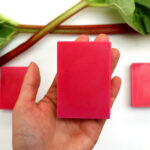
Himalayan Rhubarb Soap Recipe
A completely natural, vegan, and palm-oil-free cold-process soap recipe colored with Himalayan rhubarb root extract. The final color is a vibrant raspberry to deep cherry red. Technical information: 1lb / 454g batch with a 5% superfat and a 35.7% water discount.
Servings 6 bars
Cost 20
Equipment
Ingredients
Himalayan Rhubarb Oil Infusion
- 500 g olive oil (light colored or pomace) 17.64 oz
- 8.5 g Himalayan rhubarb powder 4 tsp
Lye solution
- 63 g sodium hydroxide 2.22 oz
- 113 g distilled water 3.99 oz
Solid oils
- 114 g coconut oil (refined) 4.01 oz (25%)
- 91 g shea butter (refined) 3.21 oz (20%)
Liquid oils
- 227 g olive oil (light colored or pomace) 8.02 oz (infused with Himalayan rhubarb) (50%)
- 23 g castor oil 0.8 oz (5%)
Instructions
Make the Himalayan Rhubarb Oil Infusion
- One month before you make this recipe, mix together the olive oil and dried rhubarb root powder in a glass jar. Store it in a dim but warm place to infuse. Give it a shake that day and whenever you can remember. By the end of the month, the infused oil will be yellow.

- When you're ready to make soap, strain the oil through a sieve. It's best to do this when the powder sediment is not agitated, so don't shake it beforehand. Bits of the rhubarb powder can cause a speckled effect instead of a homogenous color. Use this strained infused oil in place of the olive oil needed for the soap recipe. You'll have enough oil to make two 1-lb batches.

Prepare to Make Soap
- Cold-process soapmaking is chemistry, and this recipe uses lye. Lye is a caustic substance that is completely neutralized in the soapmaking process, but it can be harmful if not handled correctly. Please read this soap making safety guidance before proceeding.
- Prepare your workstation with your tools and equipment. Put on rubber gloves, eye protection, and an apron. Carefully pre-measure the ingredients. The solid oils into the pan, the liquid oils into a jug, the water into another heat-proof jug, and the lye in another container such as a glass jar or ramekin.

Make the Lye Solution
- Next, dissolve the lye (sodium hydroxide) crystals in water. In an airy place, outdoors is best, pour the lye crystals into the water and stir well. There will be a lot of heat and steam so be careful. Try not to breathe it in. Leave outside in a safe place, or in a shallow basin of water (inside or outside) to cool.

Make Cold-Process Soap
- Melt the solid oils in a stainless steel pan on very low heat. When melted, remove from the heat and set on a potholder. Pour in the liquid oils. If you have the olive and castor oils in the same container, stir them together first before pouring into the pan. Castor oil is pretty sticky and it's easier to pour when mixed with a lighter oil.

- Measure the temperatures of the lye solution and the oils. You should aim to cool them both to about 110°F (43°C). A digital thermometer is great for soapmaking, but an infrared temperature gun is miles better. There's less mess, and it's much quicker.

- Pour the lye solution into the pan of oils. I recommend pouring the liquid through a sieve to catch any potential undissolved lye. You're about to see the wonderful transformation of that pot of golden oils transforming into almost crimson!
- Dip your immersion blender into the pan and, with it turned off, stir the mixture. Next, bring it to the center of the pan, hold it to the bottom of the pan and blitz it for just a couple of seconds. Turn it off and stir the soap batter, using the blender as a spoon. Repeat until the mixture thickens up to 'Trace'. This is when the batter leaves a distinguishable trail on the surface. The consistency will be like thin custard.

- Set the mold on a piece of cardboard or a baking tray lined with greaseproof paper. Working quickly, pour the soap into the mold. Give it a tap to settle it.

- For a truly vibrantly colored soap through and through, your soap now needs to be gelled. It can be challenging to gel small batches in cavity molds by insulating with a towel. Instead, place the soap in an oven warmed to about 170°F (75°C). Turn the heat off and then leave it there overnight.
- The next day, take the soap out of the mold. You can get around six decent-sized bars of soap from this batch. You will also notice the soap deepening in color after you take it out of the mold and begin to cure it. Himalayan rhubarb deepens in color when gelled and exposed to oxygen and indirect light.

- Cure the bars for 4-6 weeks. This means leaving the bars spaced out on a protected surface in an airy place. This allows the extra water content to fully evaporate and for the pH to drop to gentler levels. Here are full instructions on how to cure soap.

- Once made, your soap will have a shelf life of up to two years. Check the oil bottles you're using, though—the closest best-by date is your soap's best-by date. If your handmade soap is destined to be gifts, check out these eco-friendly soap packaging ideas.

- Lastly, store this soap out of direct sunlight. Extended exposure to bright light can dull the vivid color to a less vibrant plum color. It might be a shade that you like, so you could always set a single bar out in a bright place and see what shade you end up with!
Video
Notes
Lastly, are you a beginner soapmaker looking for more guidance on how to make handmade soap? Enroll in the Natural Soapmaking for Beginners Online Course to get up to speed quickly. You'll learn all about soap ingredients and equipment and be guided through step-by-step soap recipe videos. Learn more