Lavender Soap Recipe
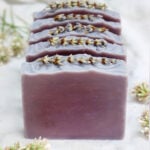
This lavender soap recipe involves creating alkanet-infused olive oil and then using it to make naturally purple soap. The recipe calls for a variety of solid and liquid oils balanced to create a hard bar with plenty of creamy lather. This recipe also calls for olive pomace oil, but you can use another light-colored olive oil if you wish. Extra virgin olive oil will give the bars a yellower color, at least initially. Makes a 454g (1 lb) batch with a 5% superfat. Depending on the mold you use, it will create 5-6 bars.
Servings 6 bars
Cost $20
Equipment
Ingredients
Alkanet-infused oil
- 1/8 cup alkanet root 2 TBSP / 11 g / 0.39 oz
- 275 g olive oil (light colored or pomace) 2.65 oz - or light-colored olive oil
Lye solution
- 63 g sodium hydroxide 2.22 oz
- 126 g distilled water 4.44 oz
Solid oils
- 114 g coconut oil (refined) 4.01 oz (25%)
- 91 g shea butter (refined) 3.21 oz (20%)
Liquid oils
- 227 g alkanet-infused olive oil 8.02 oz (50%)
- 23 g castor oil 0.8 oz (5%)
Add after Trace
- 3 tsp lavender essential oil 13.6g / 0.48 oz
- 5 dried lavender stems (optional)
Instructions
Make the alkanet-infused oil
- At least 1 month before making soap, mix the alkanet root with the olive oil in a mason jar and leave it in a dark, but warm place to infuse. Shake the jar every couple of days, and you'll get a good color extraction after a month. If you can wait longer, the color will be much deeper*. Up to a year for good, deep color. Keep an eye on the oil's best-by date if you plan to do a longer infusion period *

- Strain the infused oil through a sieve lined with cheesecloth. This double layer will help ensure that tiny alkanet pieces don't pass through. A few small ones are okay, if that happens, but alkanet can feel scratchy in soap, so try to avoid having pieces make their way through.

- Measure the amount of alkanet-infused oil needed for the soap recipe. You may have a little leftover that you can save for another batch.

Preparation
- Cold-process soapmaking is chemistry, and this recipe uses lye. Lye is a caustic substance that is completely neutralized in the soapmaking process, but it can be harmful if not handled correctly. Please read this soap making safety guidance before proceeding.
- Set out the equipment you need and measure out the ingredients before starting to make soap. The distilled water should be in a heat-proof jug, the sodium hydroxide in another jug, and the solid oils in a pan. The infused oil and castor oil can be in another jug, and the lavender essential oil in a glass ramekin.

- You should also be wearing closed-toe shoes, long pants or skirt, long sleeves, and have your hair pulled back. Wear safety goggles and gloves.
Mix the Lye Solution
- Work in an airy place, such as near an open window, and pour the sodium hydroxide into the water and stir well. There will be heat and steam, so be careful and avoid inhaling it. Leave the jug of lye solution to cool in a sink filled shallowly with cold water.

Melt the Solid oils
- Place the pan of oil over low heat, and stir and break the pieces up to speed up melting. When only a few small unmelted pieces remain, take the pan off the heat and continue stirring on the side.

- When fully melted, pour the liquid oils into the pan: the alkanet-infused olive oil and the castor oil. Save the essential oil for later. One tip for reducing air bubbles in your final soap bars is to pour the liquid oils against a spatula or immersion blender placed in the pan. It helps the liquid oils to flow in rather than splash in. Air bubbles aren't necessarily bad, just something that soapmakers try to avoid for aesthetic reasons.

Taking the temperature
- When making this small soap recipe, aim to cool both the oils and lye solution to around 110-120°F (43-49°C). An infrared thermometer makes quick work of this task, but a digital or glass thermometer works too.
Immersion blending
- When the temperatures are around 110-120°F (43-49°C), pour the lye solution into the pan of oils through a sieve. It will catch any bits of undissolved lye.
- Next, dip the stick blender into the pan and press it to the bottom. With it turned off, stir the mixture, keeping the immersion blender's head against the bottom. Next, bring it to the center of the pan, still pressing down, and blitz it for just a couple of seconds. Turn it off and stir the soap batter, using the blender as a spoon.

- Repeat until the mixture thickens up to a light 'trace'. This is when the batter leaves a distinguishable trail on the surface. The consistency will be like thin custard. The batter may look gray, purple, or blue at this point.

Essential oils & molding
- Now, at light trace, pour in the essential oil. Stir it in quickly but thoroughly. You will notice the soap getting thicker as time goes on, and you'll probably be at medium trace now—more like a thick pudding in consistency.

- Once the essential oil is fully mixed in, pour the soap batter into the mold(s). It should fill up the 1-lb loaf mold well but have a heaping top. That's fine, and what I've done here is create swirls on top with a skewer. Just use small circular motions up and down the soap. This is optional, though, and you can use whatever texture or non-texture you'd like.

- Another optional step is decorating the tops of the bars with lavender flower heads. I've only lightly pressed them in, being mindful that the buds will turn brown anywhere they touch the soap. I've placed them so that one flower head will be at the top of each bar of soap.

Cure the Lavender Soap
- Once the soap is in the mold, it helps to force the soap into gel phase. This is a period of prolonged, but gentle heat that can deepen the soap's color. It's always a good idea to do with alkanet soap recipes. There are two main ways to go about this: the first is to wrap the soap mold in a towel, protecting the top surface of the soap with cling film, and leaving it overnight.

- The second way is to oven process it, which is very easy. Heat the oven to 170°F (77°C) and place the soap inside. You can set the mold on a square of baking paper or cardboard, if you wish. Turn off the oven, close the oven door, and leave the soap in for twelve hours or overnight.

- You have the option to pop the soap out of the mold and cut it into bars immediately or wait 2 days. Waiting two days is safer since the lye used in the recipe will have fully transformed into soap.
- Wear gloves and cut the soap into bars with a soap cutter or sharp knife. After this, cure the soap for four to six weeks before using it. The purple color will fully develop during this time, and depending on the strength of the alkanet and how long it was infused into the olive oil, the bars range from light to dark purple.

- To cure the soap, place the bars in an airy but dim place with plenty of airflow. Leave them there, undisturbed, for at least four weeks before using them. You should also store handmade lavender soap in an open, dim, and airy place. Doing this helps keep the soap dry and in good condition for years.

Video
Notes
*The dark purple color you see in the images in this soap recipe is the result of using oil that was double-infused. To replicate this, infuse the oil in a warm but dim place for three months. After that, strain the oil through a cheesecloth and discard the alkanet pieces. Add fresh alkanet root to the oil and let it infuse for another three months before straining and using it to make soap.
*For a quicker infused oil, measure the alkanet and olive oil into a mason jar, then place the jar in a slow cooker lined with a tea towel. Fill the slow cooker with water to the level of the oil in the jar, and heat on low for eight to twelve hours or overnight. Then turn it off, remove the jar from the water, and allow the oil inside to cool to room temperature. Strain the oil through a cheesecloth. Make sure to squeeze the alkanet in the cheesecloth to get every last drop.
Lastly, are you a beginner soapmaker looking for guidance on making handmade soap? Enroll in the Natural Soapmaking for Beginners Online Course to get up to speed quickly. You'll learn all about soap ingredients and equipment and be guided through step-by-step soap recipe videos.