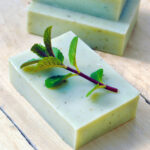
Peppermint Soap Recipe
Make minty-fresh handmade soap with peppermint essential oil, dried peppermint leaves, and green mineral color. Technical info: makes 5-6 bars, 454g / 1 lb batch, 5% superfat, and 35.7% water discount
Servings 6 bars
Cost 20
Equipment
Ingredients
Lye solution
- 65 g sodium hydroxide 2.3 oz
- 117 g distilled water 4.13 oz
Solid oils
- 137 g coconut oil (refined) 4.83 oz
- 116 g sustainably-sourced palm oil 4.09 oz
Liquid oils
- 143 g olive oil (light colored or pomace) 5.04 oz
- 38 g sunflower oil 1.34 oz
- 20 g castor oil 0.71 oz
- 1/32 tsp chromium green oxide (mineral pigment)
Add after Trace
- 3 tsp peppermint (mentha piperita) essential oil 14 g
- 1/8 tsp dried peppermint leaves
Instructions
The Soap Making Process
- When I make handmade soap I think of the process as four main parts: Lye solution, Solid oils, Liquid oils, and everything that happens at 'Trace'. Trace is when your oils and lye solution emulsifies and kicks off the saponification phase.
- Cold-process soapmaking is chemistry, and this recipe uses lye. Lye is a caustic substance that is completely neutralized in the soapmaking process, but it can be harmful if not handled correctly. Please read this soap making safety guidance before proceeding.
Prepare your Soap Making Station
- Put on rubber/latex gloves and pre-measure the ingredients. The solid oils into a small stainless steel pan, the water into a heat-proof jug, the lye (sodium hydroxide) into another container, and the liquid oils into another jug. Measure the essential oil into a small ramekin/container and the dried peppermint and chromium green oxide should go into their own small containers.
- Set up your station with your equipment close at hand and now put on your safety goggles.
Make the Lye Solution
- Work in an area with good ventilation when mixing the lye and water together. Pour the lye into the water and then mix with a stainless steel spoon until the lye crystals are fully dissolved. There will be steam and heat in this step so be cautious. Don't breathe in the steam and ensure the lye solution doesn't get on your skin. If it does, rinse it with water thoroughly.
- Set the lye solution aside to cool -- I like to set the jug in a basin (or sink) shallowly filled with cold water to speed up the process. Take its temperature with a digital thermometer. You're aiming for it to be around 100°F (38°C). It will be much hotter than that initially but keep coming back to stir and take its temperature.
Melt the Solid Oils
- Place the pan of solid oils on the hob and turn it on to the lowest heat setting. It will melt quicker than you expect, so stay with the pan, moving the oil around in the pan to help speed up melting. When there are a few small pieces of solid oil still floating, take the pan off the heat and set it on a potholder. They'll melt with the residual heat and a few stirs of your spoon/spatula.
Add the Mineral Color and Liquid oils
- Pour about a Tablespoon of your pre-measured liquid oils into the ramekin with the chromium green oxide powder. Mix it together thoroughly with a small whisk or milk frother, then pour another Tablespoon oil into the ramekin and mix it together further. Pour this colored oil through a fine-mesh sieve/strainer and into the pan of melted oils.
- Pour the remainder of the liquid oils into the pan of melted oils. Use your spatula to get every last drop.
- Sprinkle the dried peppermint over the oils and stir it in.
- Take the temperature of the mixed oils. You're aiming for around the same temperature as the lye solution, but they can be within about ten degrees of one another.
Bringing the Ingredients to 'Trace'
- When the temperatures are right, pour the lye-solution through the sieve and into the pan of oils. All in one go, no need to dawdle. Next, insert your immersion blender's head into the pan at an angle. This allows the air in the head to escape and minimizes air bubbles getting into your soap.
- Stir the contents of the pan gently, using the stick blender as a spoon. Then bring it into the center of the pan and while it's at a standstill, pulse for a couple of seconds. Then gently stir. Repeat this pulse then stir process again and again until the soap thickens up to a medium trace. This means that it will be the thickness of warm custard or pudding.
Adding the Essential Oil
- The soap will keep thickening up at this point so work quickly. Pour the essential oil into the soap and stir it together thoroughly. Then pour it into your mold(s). In the video, I pour it into a baking-paper lined take-away container. I also recommend the six-cavity silicone mold linked to in the equipment list.
Curing
- If you're using a loaf mold (like the take-away container), then you will need to insulate the soap to get a good consistent color throughout. You can line the top with plastic wrap and then cover the mold with a thick bath towel. Leave it like this for a full day. Alternatively, you could oven process the soap. Place the mold in a just-warm oven that's turned off. Leave it a full day or until the soap is room temperature.If you're using the six-cavity mold, simply leave the soap uncovered on the counter to harden up. The soap will firm up to a cheesecake consistency within ten minutes but won't be firm enough to unmold for much longer.
- Leave the soap in its mold for 48 hours. After this point, the soap will be the consistency of cheddar and will have almost fully completed saponification. Take it out of the mold with gloved hands and, in the case of a loaf, cut it into bars of the size you wish. A ruler does help here if you want bars all of the same size.
- Next, find someplace in the house that's safe from cats and kids and that is airy and out of direct sunlight. Lay a piece of baking paper down and space your bars of soap out over it. You should leave your soap there for at least four weeks to allow excess water to evaporate out of your soap and for them to fully harden up. This is called curing soap. When fully cured, you can begin using the soap and gifting it to others.
- Once made and cured, your soap will have a shelf-life of up to two years. Check the oil bottles that you're using though -- the closest best-by date is the best-by date of your soap. Cold-process soap should be stored in the open during that time, as the natural glycerin in the bars can draw moisture to them if you put them in a sealed container.
Notes
Lastly, are you a beginner soapmaker looking for more guidance on how to make handmade soap? Enroll in the Natural Soapmaking for Beginners Online Course to get up to speed quickly. You'll learn all about soap ingredients and equipment and be guided through step-by-step soap recipe videos. Learn more