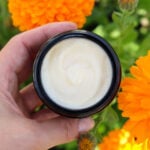
Calendula Cream Recipe
Instructions for making homemade calendula skin cream with calendula-infused oil. The texture is thick and creamy but feels light and absorbs quickly. It's ideal for hands and body, especially for those with dry and irritated skin. This recipe makes enough to fill a 100 ml (3.4 oz)* jar to just below the neck. However, you can scale it up for larger batches. Ideally, measure the ingredients by weight, but approximate volume measurements are provided as well. This recipe is intended for DIY and home use, not for professional manufacture.
Servings 100 ml
Cost $5
Equipment
- digital jewelers scale to measure the ingredients by weight
- heat-proof glass jars (2x) Mason jars work well
- large saucepan or wide pot
- square potholder or folded kitchen towel
- kitchen spoon or glass stirrer
- measuring spoons (stainless steel) optional
- jar lifter optional
- pH testing strips optional
Ingredients
Water Phase
- 55 g rose hydrosol 10 tsp / 62.19%
- 5 g vegetable glycerine 1 tsp / 5.65%
- 0.5 g baking soda (sodium bicarbonate) 1/16 + 1/32 tsp / 0.57%
Oil Phase
- 10 g calendula-infused oil 4 tsp / 11.31%
- 4 g cocoa butter or shea butter / 1.5 tsp / 4.52%
- 4 g emulsifying wax NF 1.25 tsp / 4.52%
- 1 g beeswax 1/4 tsp / or you can use 0.5 g candelilla wax to make this recipe vegan / 1.13%
Cooling Phase
- 7 g rose hydrosol 1.5 tsp / 7.91 %
- 1.5 g Geogard Ultra (Neodefend) 1/2 tsp / or another broad-spectrum preservative* such as Optiphen / 1.7%
- 10 drops rose geranium essential oil optional / or neroli or lavender essential oil / 0.5%
Instructions
Make the Calendula Infused Oil
- Before making calendula lotion, you must first make calendula oil. There are several ways to do it, and you can use different carrier oils. I use sweet almond oil for this recipe, but I also recommend apricot kernel oil. For a heavier, more conditioning lotion, you could use avocado oil or extra virgin olive oil.

Measure the Ingredients
- Measure the water-phase ingredients into one heat-proof glass jar. Measure the oil-phase ingredients into a second jar.

- Measure the cool-down phase ingredients into a small ramekin. Geogard Ultra is a broad-spectrum preservative* that comes as a powder. Mix it with the rose hydrosol until it's reasonably dispersed. You will still see small white flecks after stirring, though. Next, add the drops of essential oil to the ramekin (if you're using it). For skin safety, do not exceed the listed amounts.

Heat the Water and Oil Phases
- Create a makeshift double-boiler by placing a potholder or folded kitchen towel at the bottom of a saucepan. Set the jars containing the water phase and oil phase on top of it, then fill the pan with a couple of inches of water.

- Bring the water in the pan to a simmer. Heat the jars until the oil-phase ingredients are completely melted. Stirring helps speed this along.

- Once the oil phase is melted, remove the jars from the pan and set them on the kitchen counter. Stir both phases.
- Carefully pour the water-phase ingredients into the oil-phase jar. The contents will turn an opaque, creamy color but still be liquid. Now it's time to blend.

- Stir the ingredients together using a spoon or glass stirrer for a minute. Leave it to rest for a minute, then stir again. Repeat until the calendula cream begins thickening—it can take up to twenty minutes when stirring by hand.

Cooling Phase
- When the cream is 40°C (104°F) or cooler, add the cooling-phase ingredients and stir well*.

- Spoon the calendula cream into a clean and dry container. I use a silicone spatula to get every last drop. Allow it to cool to room temperature before sealing it with a lid.
- If you've used the Geogard Ultra preservative, the finished calendula cream recipe can have a long shelf life*. Once you start using it and putting your fingers in the cream, you should try to finish it within six months. This is a conservative personal use recommendation, not a specific shelf life.
Video
Notes
* The ingredients by weight may not seem to add up to 100 ml (3.4 oz), but the approximate final volume is accurate.
* Broad-spectrum preservatives come in powder and liquid form, and you can choose another type if you wish. Always adhere to the manufacturer's recommended usage rates and instructions.
*This recipe has a pH of 5.5 when I make it. However, it's always best to test your batch using a pH meter. Skin cream pH should be 5 to 5.5, and many preservatives are only effective at particular pH values. For example, Geogard Ultra only works at pH 3-6.5, and if the cream is outside that range, microbes can grow.
*The shelf life of this product can vary depending on many factors, including packaging and manufacturing hygiene. However, using a preservative can help it last many months at room temperature.