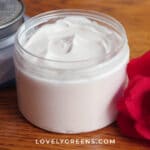
Rose Hand Cream Recipe with Honey and Rosewater
Step-by-step instructions for making a rich and moisturizing handmade rose hand cream recipe. Uses rosewater and honey and makes one 100ml pot but can be scaled up for larger batches.
Servings 100 ml
Cost $20
Equipment
Ingredients
Homemade Rosewater (optional step)
Water Phase
- 2.37 fl. oz rosewater 70 ml
- 1/4 tsp honey 2 g
- 1/2 tsp sodium lactate 2 g
Oil Phase
- 0.35 oz emulsifying wax NF 10 g
- 0.35 oz rice bran oil 10 g
- 0.18 g shea butter (refined) 5 g
- 1/16 tsp xanthan gum
Cooling Phase
- 0.18 oz rosehip seed oil 5 g
- broad spectrum preservative* Such as Leucidal SF Complete
- 2 tsp rosewater
- 20 drops vitamin e oil Optional
- 5-10 drops rose absolute Alternatives: rose otto or rose-geranium essential oils
Instructions
Make the Rosewater
- True rosewater is the byproduct of rose essential oil distillation. You can either purchase it to use in this recipe or make a simple rose-infusion. The process is over here and usually results in a pink liquid. True rosewater is clear.
Prepare the Oil & Water Phases
- Sterilize all of your equipment by running it through the dishwasher. Wash your hands thoroughly, and consider wearing disposable gloves while making rose hand cream.
- Measure the ingredients of the oil phase into one heat-proof glass jar. Stir well to incorporate the xanthan gum.

- Measure the water phase ingredients in a second jar. Next, place both the jars in a large saucepan that has a folded kitchen towel or washcloth at the bottom. This is to keep the direct heat of the pan from cracking the glass jars.

- Fill the pan with an inch of water. Bring it to a boil then reduce the heat to a simmer. Keep the jars in the hot water until the oil phase is completely melted and the contents of both jars are about 165°F (75°C). Take the jars out, and place them on a kitchen towel on the counter.
- Next, pour the water phase into the oil-phase jar. You'll see it immediately turn an opaque milky color. Gently stir with a spoon for several minutes, then let it cool for ten minutes. Leave the spoon inside the jar since you'll need to return five minutes later to give it another stir. At this point the cream will be liquidy, so don't panic if it's not thick.

Cooling Phase
- Cool the hand cream to 120°F (49°C). As it cools, it will thicken up slightly. Return every twenty minutes or so to gently stir.
- When the rose hand cream has cooled, stir in the cooling phase ingredients. If the preservative you're using is powdered, mix it with the rose water before stirring it into the cream.
Testing the pH
- Now we need to test for pH. Stir a half teaspoon of rose hand cream in 1-2 tsp distilled water. Dip one of your pH papers into liquid and then compare the color to the ones on the pack. Lotion and skin creams need to match the pH of your skin, or they can be irritating and affect the effectiveness of preservatives. If the pH is between 4.5-5.5, you're spot on. You can make the hand cream more acidic (lower the pH) by adding tiny amounts of lactic acid or citric acid dissolved in a small amount of warm, distilled water. Make it more alkaline (increase the pH) with triethanolamine or by dissolving a small amount of L-Arginine or bicarbonate (baking soda) in water and adding it. Pass it through the sieve and into the lotion. Take the pH reading again and adjust again if needed.

- Using a rubber spatula, spoon the rose hand cream into a sterile container and seal. You can begin using it immediately but it will continue thickening up over the next few days.

Notes
* I use 1/2 tsp (1.5 g) Geogard Ultra preservative when making this recipe. You can use another broad-spectrum preservative for skin creams, though. If you do, follow the manufacturer's instructions. Also, if you make this hand cream without a preservative, it will last up to one week in the refrigerator. After that time, invisible bacteria and fungi will begin colonizing it, and it will probably not be something you want to put on your face. Microbes love a water-based environment.