
Easy Strawberry Jam Recipe (No Added Pectin)
This article contains affiliate links. As an Amazon Associate, I earn from qualifying purchases.
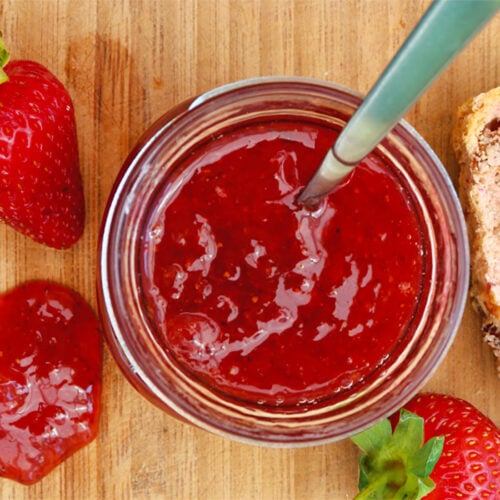
An old-fashioned strawberry jam recipe with incredible fresh strawberry flavor. It doesn’t include added pectin, yet it sets firm and juicy, and it’s extremely easy to make. All you need to make it is fresh strawberries, white sugar, and lemon juice.
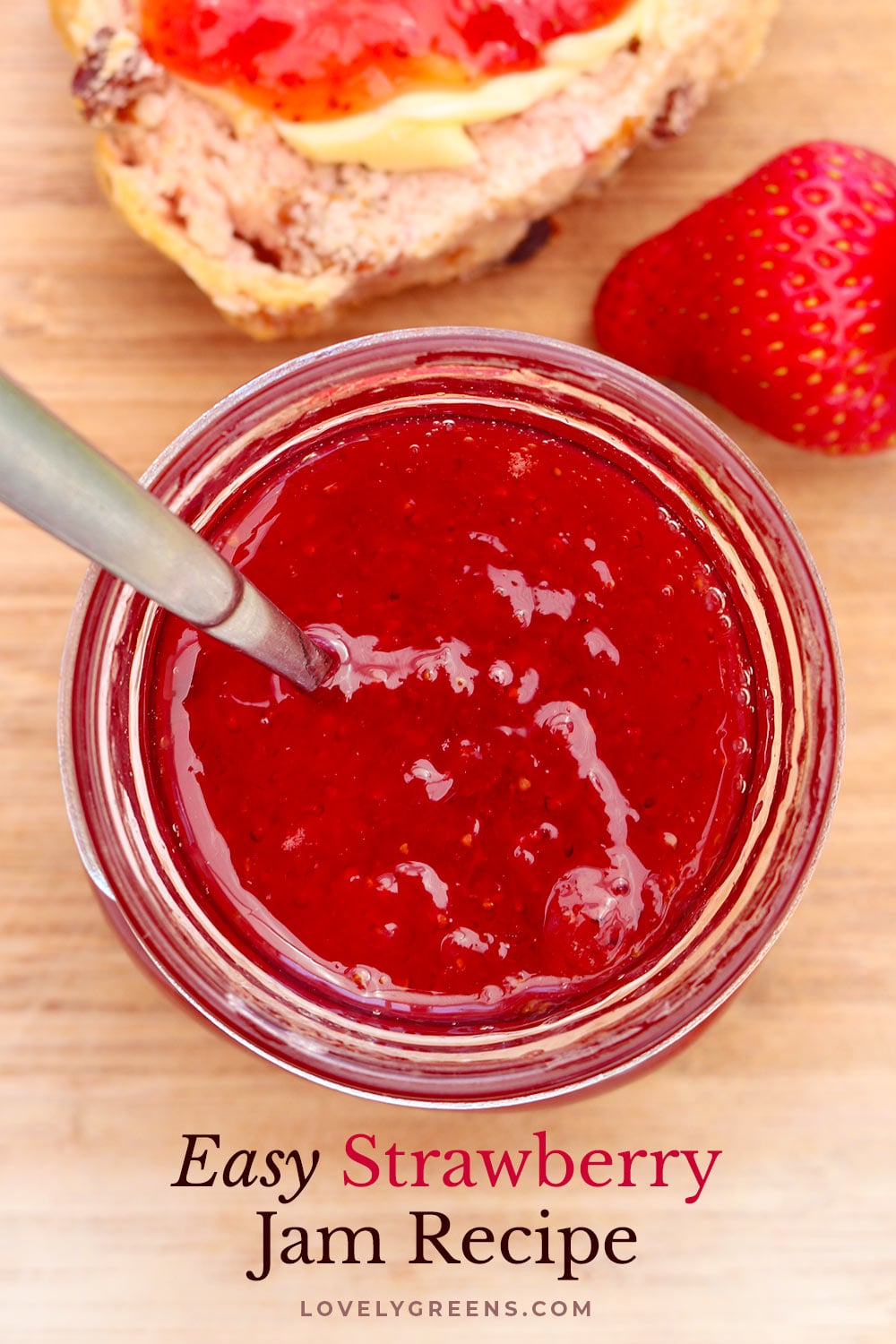
Nothing really beats the flavor of a freshly picked strawberry, but strawberry jam comes a close second. It’s also relatively easy to make and preserves bumper harvests or on-sale berries for at least a year. That way, you can enjoy that quintessential taste of summer long after strawberries are out of season. Just imagine grabbing a jar out of the cupboard in winter and spooning homemade strawberry jam over fresh yogurt, toast, or sandwiches—it’s pure joy!
Making your own also saves a load of money, and if you grow your own strawberries, it helps preserve big June gluts. This recipe is also quick to make, and you can have it prepped, cooked, and poured in about an hour. After that, you can store it away in your pantry for many months. Homemade jam is best used within one year of making it, but it can last longer.
How to Make Strawberry Jam
If you’ve not made strawberry jam before, let me give you a run-down of what to expect. You begin by cleaning and cutting up fresh berries, then adding them to a pot with sugar and lemon juice. You’ll then boil and mash this mixture until it reaches the setting point—the point at which the pectin sets the juice into a gel.
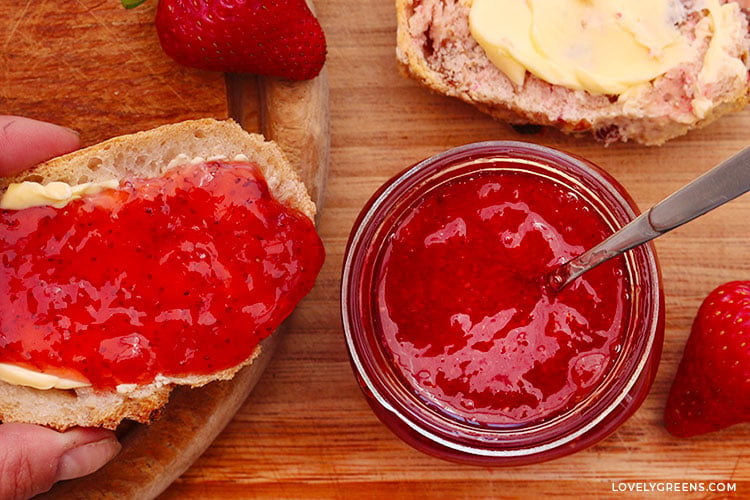
After that, you skim the foam off the top, pour the hot strawberry jam into jars, and seal them. You can also water-bath the jam afterward for long-term storage. Once opened, strawberry jam should be kept in the fridge and will last about six months.
Choose High-Quality Berries
When you preserve any fruit or berry, make sure it’s fully ripe, juicy, shiny, and has no signs of rot. If there are small nibbles on them, you can cut them off, but avoid using ones that look degraded or shriveled. Ripe and fully red is best, but if you have a few that are a little over- or underripe, that’s okay, too. One thing I really recommend is using berries that are in season and taste great. Store-bought strawberries are often bland and flavorless, making them not ideal for preservation.
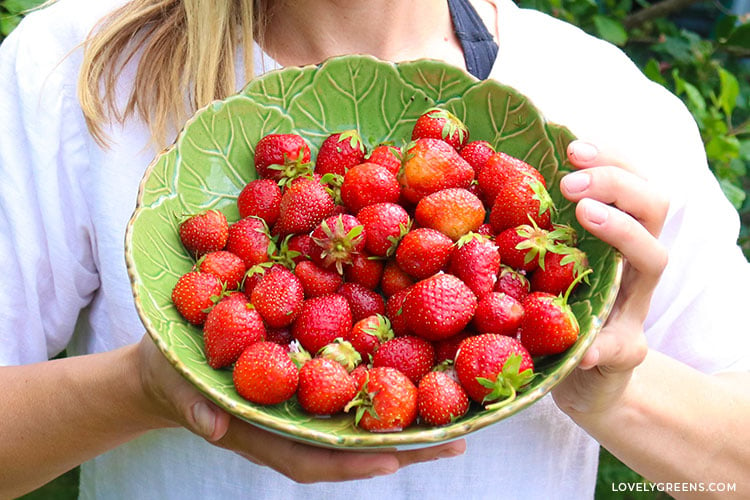
Growing your own strawberries means that you have the choice of dozens of different varieties. I grow Marshmello, Mara des Bois, Elsanta, Honeoye, Malling Centenary, and pineberries, a white-to-blush-pink berry. You can use any strawberry, including pineberries, to make homemade jam. I’ve done it before, and while the flavor is incredible, the pale color is underwhelming. You can make it pink by adding a few red strawberries into the mix, though.
No Pectin Strawberry Jam Recipe
Pectin is a natural substance that helps jam or jelly gel. While some fruit and berries set beautifully into jam due to high quantities of natural pectin (redcurrant jelly, for one), strawberries contain very little.
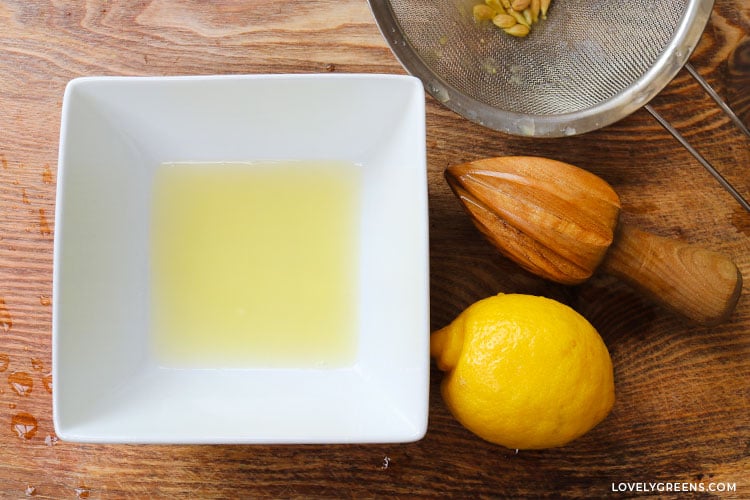
That’s why most strawberry jam recipes include added pectin, which you can buy in sachets, in liquid form, and in some places, mixed into white sugar. This recipe doesn’t need any of those, though! Instead, we use lemon juice, which is naturally very high in pectin. It also naturally contains citric acid, which adds flavor and a zesty kick!
For preservation, it’s better to use bottled lemon juice since its acidity is standardized. For this recipe, I always use fresh lemon juice because the amount needed exceeds the acidity required for safe preservation. The lemon juice also makes this strawberry jam recipe absolutely delicious!
Jam Making Equipment
Making jam isn’t complicated, but you’ll need a few things to get started. If you’re not comfortable using the plate method to test the setting point, you could use a candy thermometer instead. Jam and jellies have an ideal setting temperature, and it will tell you when the mixture has cooked enough.
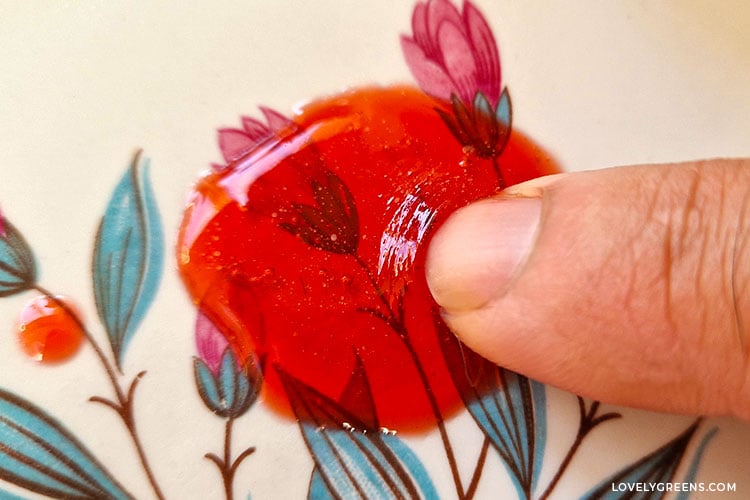
In my opinion, the cold plate method is very easy, and I rarely use a thermometer when making jam or jelly. Here are some other pieces of equipment that you’ll find useful:
- Mason jars or jam jars
- Lids for canning jars, such as BPA-free Tattler lids
- Stockpot or maslin pan
- Jam funnel (a must-have, IMO!)
Strawberry Jam Ideas
Once you’ve made it, how do you use strawberry jam? That’s easy for some—slather it over toast, peanut butter and jelly sandwiches, or spoon it over Greek yogurt or vanilla ice cream. You also use it on pancakes, as the jam layer in a Victoria sandwich, homemade cheesecake, or other desserts. The sky’s the limit! And if you’re looking for even more strawberry inspiration, check out these ideas:
- Strawberry and Rhubarb Pie Recipe
- Strawberry & Rhubarb Jam Recipe
- How to Build a Strawberry Pallet Planter
Easy Strawberry Jam Recipe
Equipment
- jam jars and lids (Mason jars or other)
- preserving pan (or large pot or saucepan)
- candy thermometer (optional)
Ingredients
- 2.2 lbs fresh strawberries (cleaned and chopped / 1 kg or 5 cups)
- 5 cups white sugar (2.2 lbs / 1 kg)
- 1/4 cup lemon juice ( 85 g / you can use 1/3 cup for a firmer set. Bottled is better than fresh, but you can use either.)
Instructions
Sterilizing Jars and Lids
- Clean and sterilize your jars. Run them through the dishwasher or heat the glass jars in the oven. For the oven method, leave them in for 20-30 minutes at 275°F (130°C) about half an hour before you start cooking your jam. The jars should ideally be warm when you pour the jam inside.
- To sterilize the lids, I pour boiling water over them and leave them in for five minutes. They should be dry when you use them to seal your jars.
- Put a plate in the freezer for use later in testing the setting point.
Prepare the Ingredients
- Rinse the strawberries and remove the green leaves. There's no need to hull them, just twist the leaves off or slice them off with a knife. Try not to cut too much of the berry off, though.
- Quarter the berries with a knife and weigh them out again to ensure that you have enough. Place them in the cooking pot.

- Pour the lemon juice over them and then the sugar. Stir to coat.

Make Strawberry Jam
- Warm the pot on medium heat until the sugar has completely dissolved and the pan has filled with liquid. Stir it regularly.
- Next, turn the heat to medium-high and bring the strawberries to a full rolling boil. Keep stirring, and reduce the heat to keep the boil steady but not overly energetic. Boil like this for twenty minutes. Setting a wooden spoon across the top of the pot helps stop the mixture from boiling over.
- As they boil, the berries will break down some on their own. If you don't want big pieces of strawberry in your preserve, use a potato masher to smoosh the berries as they cook. Be careful of the hot juices and steam.
- After cooking for twenty minutes, test for the setting point. Dribble some jam on the frozen plate you prepared earlier. Wait about thirty seconds for it to cool, and then push it with your finger. If it's clearly firm or starts crinkling up, it's time to move on to the next step. If it's still liquidy, you need to boil for longer.
- You can also identify the setting point by temperature. Before proceeding to the next step, use a candy thermometer to ensure the jam is 220°F (104°C).
- Turn the heat off and set the pot on a pot holder. Allow it to settle for a minute, then use a spoon to scoop the foam from the surface.
- Pour the hot jam into warm, sterilized jars. Fill them within a 1/4 inch (6 mm) of the top of the jar and seal them immediately with the lids. If you're using lids that require screw rings, tighten them firmly.
- If the jars aren't filled to within a quarter-inch of the rim, the lids may not form a proper seal. Should that happen to any jars, refrigerate and use them within six months.


Water Bath Canning
- When making jam in Britain, you tend to stop here and let the jam cool and seal on the counter. People have been making jam like that for decades – even preserves sold at Farmers' Markets! As far as I'm aware, no one has died or gotten sick from not water bathing jams and jellies. However, there is a chance of mold developing, so it's best to water bath. Doing so also ensures a seal and makes the jam even more shelf-safe.
- Fill a tall pan with hot water and place a rack at the bottom. Lower your jars in so that they're not touching and that there's at least an inch of water above.
- Bring the water to a boil and leave the jars in the water for five minutes if you sterilized the jars and lids beforehand. Ten minutes if you didn't. Lift them out with a jar lifter and set them on the counter to cool.
- Leave the jars on a counter to cool down and seal. If you're nearby, you'll likely hear a pop for each jar as it seals.
- If you're not sure if some jars have sealed, press the top of the lid. If it moves up and down easily, it's probably not sealed. If it's firmly yet subtly indented downwards, then it's sealed. Any that have not been sealed should be refrigerated and eaten first.
- When the jars are at room temperature and sealed, store them in a cool cupboard or larder. Sealed, they'll keep for at least a year. Once open, refrigerate and use within six months.

Notes
Love our recipes?
✦ Add Lovely Greens as a Google Trusted Source
Great recipe! As a side note, could the Imperial measurement be stated in pounds and ounces, as 2.2lb, which is mixing Imperial with decimal is slightly confusing to me!
I made this jam last year and everyone loved it!! We used fresh picked strawberries and it tasted delicious! My only question is how long does this jam last? With it being canned does it last a year?
Hi Kenzie, it lasts for at least a year and probably a lot longer than that. For myself personally, I’ll open a jar and if it looks and smells like yummy jam, we’ll have it. Sometimes jam that’s several years old can be perfectly fine!
Thanks Tanya, strawberry harvest is in full swing here on our farmstead. I harvested 24 cups yesterday alone. Thank you for the recipe, I’ll try it.
You’re welcome! WOW…what a harvest you have.
What is jam sugar please ?
It’s sugar that has added pectin and ready to make preserves.
What does it go best with?
With anything you like! It’s a sweet and easy way to make traditional strawberry jam.
I love strawberry jam on a fresh, hot biscuit…..as in American biscuits, not British biscuits, which are cookies to us, lol. American biscuits are more like British scones. It’s nice on plain old toast too.
I’ve just had this strawberry jam with greek yoghurt — delish. If anyone has questions on how to make it please leave a comment here. All the best ~ Tanya