
Growing Alkanet, a Natural Purple Dye (Alkanna tinctoria)
This article contains affiliate links. As an Amazon Associate, I earn from qualifying purchases.
A story of finding seeds and growing alkanet. Alkanna tinctoria roots are common and used to naturally tint soap and food, but sourcing the plant and finding out where it is harvested for commercial use remain a mystery.
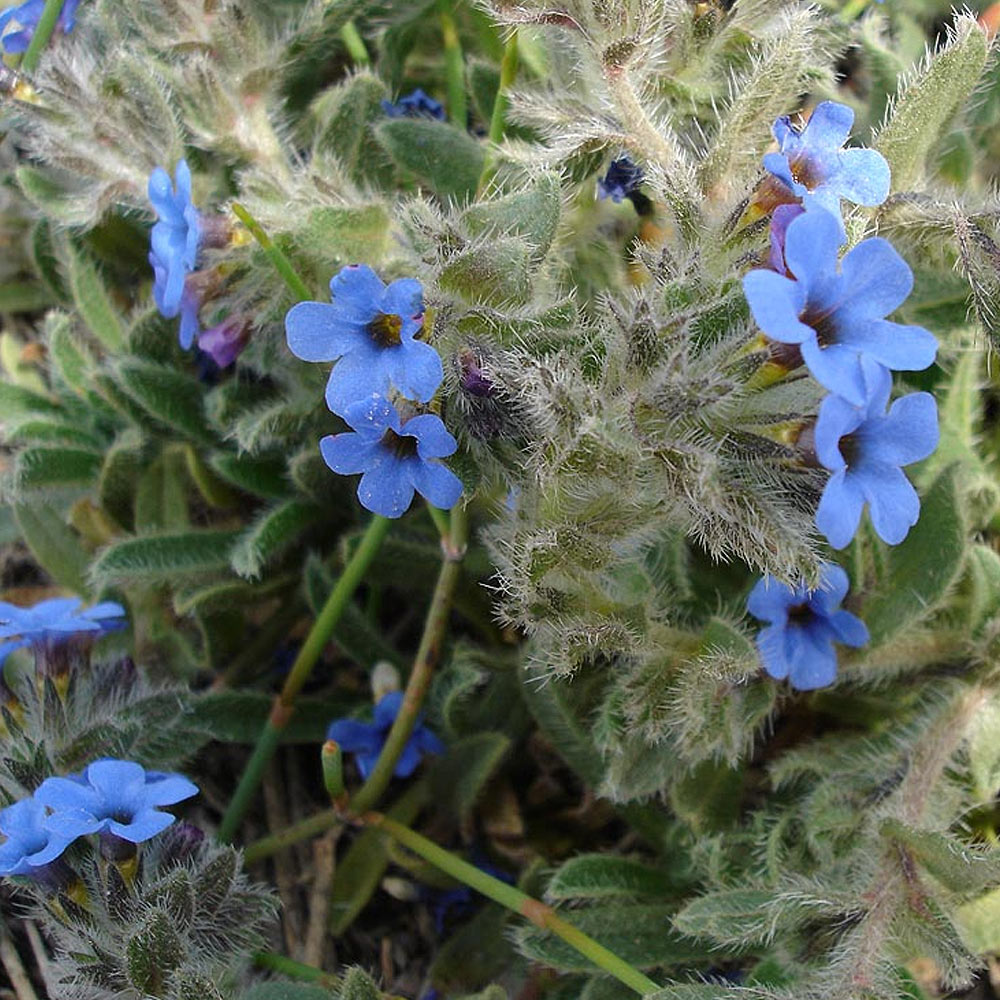

As a natural soap and skincare producer, I use plant extracts to infuse color. I do this to keep my products closer to nature, and I love the natural tones they produce. In cold-process soap, I can achieve pinks with madder root, blue with woad and homegrown indigo, yellow from goldenrod and calendula, caramel from honey, beige with peppermint, and purple with alkanet.
Most of these plants grow in my garden at home, but Dyer’s alkanet has been difficult for me to find. I had to scour the internet for a month before finding a lead on some seeds. It seems that commercially available alkanna tinctoria is wild-harvested1, and the plants may be threatened in their native habitat. Their seeds also have a low germination rate, and because they take so long to grow, no commercial growers are publicly known.
No One Seems to Grow Dyer’s Alkanet
The first stop to trying to find Dyer’s alkanet was in speaking to the folks at Wild Colours in the UK. This is where my current batch of alkanet root came from, and I thought I’d call and see if they could sell me some seeds.

It turned out that the business owner, Teresinha Roberts, has been after some seeds for some time. They’re extremely difficult to find, and it’s almost impossible to actually speak to the growers of commercially farmed alkanet. Our email conversation ended with me letting her know I’ll pass on some seeds if I can find any.
Finding Seeds in the USA
After that, I called every major seed distributor in the UK, but they could only source common alkanet. This plant looks similar to Dyer’s alkanet, and you can even use it in dyeing, but it doesn’t have alkanna tinctoria’s deep purple color. After those calls, I occasionally went onto Google to see if I’d have any luck.

I was at the point of giving up when I came across an old post for a dyers workshop run by a Ms. D in the USA. The post mentioned that she grew her own dye plants and that alkanet was to be used in her course. I found out that she does indeed grow alkanet and’d be more than happy to send me some seeds.
Alkanna Tinctoria Seeds
A small packet arrived for me at the end of May, and I immediately set to sowing them. Ms. D said that they have about a 20% germination rate and grow in conditions similar to their cousin, borage. I was relieved since I have tons of borage sprouting like weeds in my garden. I think I’d have been a bit more nervous if it had been any more difficult to grow. It really took some intense detective work to find them in the first place.

If you’re looking for seeds yourself, an online shop called Strictly Medicinal Seeds has supplied them in the past. However, they always seem ‘out of stock,’ and after enquiring, it seems that the plants they have grown haven’t done very well. That was in 2019, and I’ve not seen them for sale on their site since. Alkanet is also sometimes listed as Ratan Jot (though technically, that’s a different plant), and there are some bulk suppliers from India. It seems most alkanet produced worldwide now comes from that region.
Good Germination Rate
Alkanet needs warm conditions to grow, so I plan to plant undercover. Fortunately, I had a really positive germination rate, and 13 of the 30 seeds I started sprouted. That’s nearly half of them. Since then, I’ve let them grow in the seed tray until they put out two true leaves, then planted them into individual modules.
Growing Alkanet Seedlings
It’s quite late to be growing these seedlings, but with luck and protection, I believe I can keep them going until next year. That’s when I’ll plant them in their final positions. As a perennial, they prefer warm, sandy soil with a neutral or even alkaline pH. They’re also relatively hardy, and though they love hot summers, they can survive temperatures as low as 14°F (10°C).

When growing alkanet, expect the plants to form rosettes of leaves in the first year. You need the roots for natural dye, but you have to be patient for the harvest. You can harvest them as early as after the plant flowers in the second year. As with many herbal roots, it’s probably best to wait until autumn to harvest. That’s when many plant roots are at their peak after a summer of storing energy.
Using Dried Alkanet in Soap
If you buy Dyer’s alkanet, the dried roots that arrive should be a deep and dark purple. If they’re not very purple and are more of a dark brownish-red, you may have been sent ratanjot (Onosma echioides). It’s used in Indian cooking, and the internet seems determined to convince everyone that it’s the same thing as Dyer’s alkanet (Alkanna tinctoria). They’re different plants, though, and Ratanjot will not give you deep purple soap. I know this from disappointed experience.

If you have true Dyer’s alkanet, you can infuse the dried roots in a carrier oil to extract the color. Right now, I have a large glass of olive oil sitting in my kitchen window doing this very thing. Over about a month, the oil will turn a beautiful, vibrant red, and you can use the strained oil in soap recipes, such as this lavender soap recipe.

Alkanet as a Food Dye
Dyer’s alkanet is also a traditional food dye, but it contains alkaloids that make it unsafe to eat. That’s why you shouldn’t use it to tint lip balm or any other product that you might ingest. In the past, it was used to naturally dye the Indian dish Rogan Josh and inferior port wine to improve its color.

However, alkanet is mainly used today to naturally dye wool and cloth. The colors can range from soft lavender to rich purple, and even reds and greys. The final color depends on the technique you use to extract it, such as soaking alkanet root in rubbing alcohol.
Hoping To Grow Alkanet
My alkanet seedlings are still small, but I have high hopes for them. One of my goals is to grow all of my own skincare plants. Alkanet always seemed like the one I might not be able to grow, and without small producers like Ms. D, I’m sure I might never have had the opportunity to grow it. It seems we increasingly have to rely on our gardener friends and neighbors around the world to preserve and share lesser-known, traditional plants. Thank goodness we have the internet to connect us and help with sharing.
Update on the Alkanet Seedlings (2026)
I wrote the piece above many years ago, and since then I’ve had many people contact me for alkanet seeds and seedlings. Unfortunately, the seedlings grew for some time but then failed. I’ve since learned that Dyer’s alkanet doesn’t like cool, damp climates like mine, and I haven’t tried growing them again.
I probably won’t because my climate would make it difficult to give them the environment they need. They thrive in dry, sandy soil, with hot summers and cool winters. Alkanna tinctoria grows wild in Greece, southern France, Bulgaria, Turkey, and into the northern parts of the Middle East and India. It’s a wild Mediterranean plant that is increasingly losing habitat, and I hope that we don’t lose it altogether one day.
- How to Grow Calendula Flowers (yellow dye)
- Growing and Extracting Indigo (blue dye)
- How to Grow English Lavender
- Healing Plants to Grow in a Salve Garden
- Zhao, Y., Cartabia, A., Garcés-Ruiz, M., Herent, M.-F., Quetin-Leclercq, J., Ortiz, S., Declerck, S., & Lalaymia, I. (2023). Arbuscular mycorrhizal fungi impact the production of alkannin/shikonin and their derivatives in Alkanna tinctoria Tausch. Grown in semi-hydroponic and pot cultivation systems. Frontiers in Microbiology, 14. ↩︎
Hi, just noticed this plant growing in a rotten stump with a growing hickory stick.
I live in zone 6/7. Soil is mostly clay that doesn’t drain well.
I did not plant it.
How common is it?
Sorry, Ree, but it’s not Dyer’s alkanet (Alkanna tinctoria). It may be green alkanet (Pentaglottis sempervirens) or another alkanet species, but Alkanna tinctoria is quite fussy about soil and climate. It likes free-draining soil (sandy soil) and only grows in Mediterranean climates. You can find it growing wild in Greece, Spain, Italy, North Africa, and other countries in that region. It does not grow wild in the USA.
Hi, I’m in Australia and alkanet seeds are quite easy and cheap to obtain. I grow mine in between my borage.
The type of alkanet you grow may be different to the type used for natural dyeing. There are several plants called “alkanet” but only one that yields the rich purple dye. I see that Anchusa officinalis and green alkanet (Pentaglottis sempervirens) is quite common in Australia and wonder if that’s what you grow.
I realize this is an older post, but if anyone’s interested, I was able to purchase gromwell seeds that give the ‘murasaki’ purple color from Grand Prismatic Seed. I grew them this summer in Connecticut, zone 6a. The color molecule from gromwell is shikonin which is very similar (enantiomer) to the molecule in alkannet, alkannin. I’m doing a water extraction with the fresh roots right now. Fingers crossed.
That’s very useful information indeed! Thank you Sidney :)
Woolery has some seeds, thank you for posting how you grew them, I’m looking forward to my seeds sprouting
Hi MH, it’s a different type of alkanet (Anchusa officinalis) and will not give you the beautiful purple color of dyers alkanet.
I will not travel to Greece this year but if you can send me some seeds of Alkanna tinctoria, I would be very grateful.
Hello, you managed to get seeds? I’m also trying to get seeds Alkanna tinctoria. So far without success.
Hi Tanya, You are probably getting fed up with people asking you for Alkanna tinctoria seeds. I see from the correspondence here that you are no longer growing them but I was wondering if you had any updates on where you might be able to locate some. About 3 years ago I bought what was advertised as Alkanna tinctoria seeds from a German supplier “Ruhlemann’s” however the plants I grew turned out to have white roots without a trace of colour. I believe the seeds suppliers had bred a variety for its flowers and possibly for its medical properties and not for the dye and as a result had lost the red roots. Any help you could give would be much appreciated and If I can help in return in any way with dye plant seeds etc just ask. I see you have been involved in a social and therapeutic horticulture project at the local detention center. Interesting to me too as I am a horticultural therapist also.
I’ve been in touch with someone who lives in France and is interested in investigating this. I still can’t believe that after all these years that Dyers Alkanet is STILL such an issue to get a hold of.
Dear friends, I live in Greece and I am an agricultural engineer and plant pathologist. In my area (Korinth, Peloponnese), Alkanna tinctoria grows everywhere in the nearby mountains so it seems to me strange that someone is trying to find seeds. If anyone travels to Greece I would gladly share any knowledge with you and point some harvesting areas.
I would so love to get Alkanet seeds, please — thank you Katherine Jewell
I just received Alkanna tinctoria seed. From what I have read it says to give the seeds a cold treatment for several months in the fridge. But reading about your experience growing these seeds you started them in good potting soil with good results. So I am double checking with you whether you gave cold treatment. The seeds are so tiny and hard to find that I want to do it right.
Thank you.
If they came with those directions then follow them, I’d say. Mine came from a lady in the US with no particular growing instructions. They germinated without being stratified (cold treatment) but since the seeds are dear I’d follow your instructions to the T. Could you share where you got a hold of your seeds from?
Hi, Theodore Katsamakis, are you able to harvest and post seed?
Thank
Jo
Hi, if you get some true alkanet seeds, research a little for what’s allowed for import in the US, or Canada, for that matter. Check sites on the web for information.
The Border Protection folks have to seize and discard many organic items, including fresh fruits, vegetables, seeds, plant cuttings, and anything else of that ilk. They are pretty diligent.
Awesome
I’m sorry Anna but I’ve not grown it since the year I wrote this post. If I hear of any other sources I’ll let you know though.
Hi I recently found this beautiful plant in Greece growing in pure sand about 50 meters from the beach. The article was very interesting I will be looking out for the seeds when the time comes.
Hello Tanya!
I am very interested in growing some alkanet and as you mentioned in your post it is very difficult to find seeds. Wondering if you have any or know how I can contact ms. D or someone who does. Thanks so much and great post and site. Michelle
I found seeds originally through a natural dyer in the USA but to be honest haven’t been able to find seeds or plants anywhere else. I’d recommend you get in touch with a local natural dyer if you’re interested in finding out more.
Hi Lora and Mine – unfortunately it turned out that Alkanna Tinctoria prefers a much warmer climate and didn’t thrive here on the Isle of Man. I now have a native Alkanet growing in my garden but I don’t use it for dyeing since the pigment from it isn’t as strong and because I’ve now moved on to using primarily minerals to achieve blues. So I’m sorry but I don’t have any seeds for you.
Mumasu – the idea of harvesting at the end of the season or before the flowers form/bloom is that the roots have a lot more energy (colour) at those times. At other times, the roots are more of a piece of equipment for supplying food to the leaves and flowers.
Hi, I will like to buy some seeds from you, if is possible. Thanks
Dear Tanya,
I have been looking for alkanna tinctoria seeds for a while. It seems only way to get them is from other dyers. Could you share some of your alkanna tinctoria seeds with me?
Yours
At the risk of being thick can I ask a question! Why do you need to harvest the roots before the plant flowers. Are you going to harvest some and let some run to seed. Do the dying properties in the roots change after the plants have flowered. Do you have to kill the plant to harvest the roots.
Sorry that's lots of questions. Well done for your dedication in tracking down the seeds in the first place.
Tanya this is a lovely post, and so interesting. You are obviously very committed to producing the best natural products you can. The lavender soap looks so good, and beautifully presented.
I was going to say how lucky to find those seeds but it's not luck at all – it's your dedication that did it. It must have felt like holding a bag of treasure when you received your seeds, so exciting! I'm sure that the plants will thrive under your care, Tanya, you're willing them on to success! Best of luck with all this, xx
Such a beautiful colour and congratulations on finding the seeds. We will follow their progress with interest xxx
Thanks Fran – they certainly are a beautiful colour aren't they?
What an interesting post! Great information and I just loved the photos. :)
Thanks Staci – I have another great photo of various dyed wool using different natural colours and I was deliberating with putting it up or not. Ms. D sent it to me and I think I'll get a bit more information on which plants she used before I put it up.