
13 Spooky & Haunted Places in the Isle of Man
This article contains affiliate links. As an Amazon Associate, I earn from qualifying purchases.
Spooky and haunted places to visit in the Isle of Man, including haunted houses, vampire graves, and strange and sad tales. This guide also includes a map so you can visit each one, too!

The Isle of Man is a quiet place of rolling green hills and rugged natural beauty. It’s also a land steeped in history with ancient stone circles, legends of monsters, and ghosts wandering the homes of both the mighty and the humble. The Vikings have raided and conquered, and bloody battles have been fought here.
Tales of witchcraft, murder, and public executions lie hidden behind the doors of this secluded island in the Irish Sea. With Hop tu Naa (Halloween to the rest of you) around the corner, here’s an introduction to thirteen of the spookiest and most haunted sites you can visit…if you dare. If you’d like to visit these places but aren’t sure where they are, use this map.
Seat B14 at the Gaiety Theatre
Both the seat and the area around it are said to be haunted by an elderly woman who lost her husband in the war. She’s been seen by many and is described as looking like an unassuming grandmother, at least until she does something odd like walk through a wall.
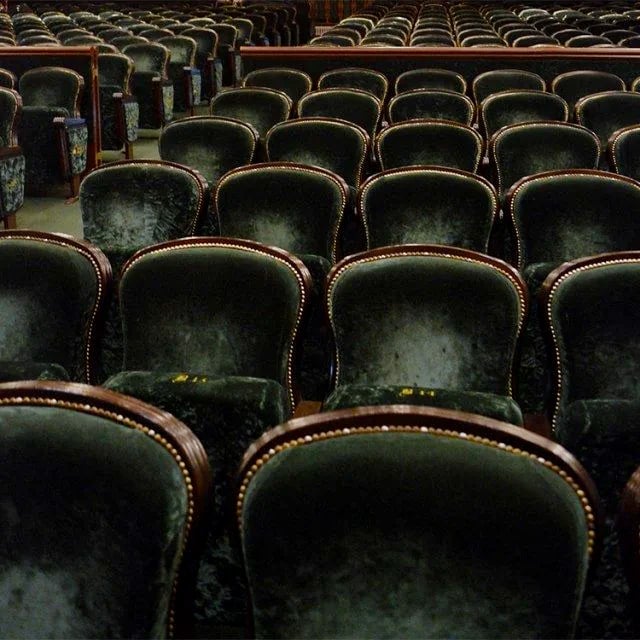
B14 was her favourite seat, and she’s said to still come to watch the shows she loved so much while she was living. Other ghosts are said to haunt the Gaiety, too.
The Vampire Grave in Malew Churchyard
Matthew Hassall seemed an ordinary Manxman until the day he died and loved ones gathered at his wake. Then he sat straight up and frightened everyone present! Declared a Vampire, it was decided that he could not officially be buried in hallowed ground with his beloved wife Margaret.

The legend goes that his grave was dug from behind the stone wall the grave stands against (the old boundary of the churchyard), and his body was placed inside. Just to make sure he didn’t rise again, a stone slab was placed over his corpse, and iron stakes and chains cover the grave to keep him in. These chains have remained from the 1800s to the present day.1
Witch Burning in Castletown
If you’ve been to Castletown, you’ve no doubt seen the Smelt monument in the town square. On one side is a wooden plaque that states the fate of a local woman who was accused, along with her son, of riding broomsticks around fields to encourage crops to grow.2 Both were held as prisoners in Castle Rushen and on their last day were dressed in white gowns and taken by cart to Peel where they were put on display as a caution to would-be witches3. Afterward, they were taken back to Castletown for execution by fire.

“The Ancient Market Crosse
On this site until early in the 18th century stood the market cross. In the year 1617 Margaret Ineqane and her son were condemned to death for witchcraft, and burned to death at the stake close to the crosse”
The Ghosts of Castle Rushen
A castle has stood on this site since around 1200, and the current structure dates to 1344. With both prisons and executions held within its walls, it’s no surprise there are also ghost stories. Three of these ghosts are women known as the White Lady, Rose, and the Woman in Black. A mysterious underground room in the castle is also said to be haunted by a male ghost.

The ghost walk at Castle Rushen is said to be one of the best on the Island, and I agree. I went one evening about a decade ago, and it was incredibly spooky!
Mass Cholera Grave in Douglas
In June of 1832, Cholera arrived on the Isle of Man. This fatal disease swept from India along trade routes to Moscow and then to Europe and England. Newspapers reported the epidemic finding its way to Liverpool in May 1832, and it was a month later that it reared its head on the island. It caused panic and in the end killed 83 people, who were all buried together in a mass grave at St George’s Church. It has been implied in a newspaper article of the time4 that the number of people who died could have been lower if it weren’t for how people reacted to the deaths. They reported:

“We witnessed in the course of the last week a bin in Sand Street waiting to receive a cholera corpse and the house was crowded with persons, mostly women and children who were eager to see the dead. Several of these have paid the fatal foreiture for their curiousity.”
Haunted Milntown Mansion
Milntown is, for many, a beautiful and historic house on Lezayre Road in Ramsey. It has extensive gardens, a restaurant, and a lovely high tea service that I can highly recommend. The main part of the house is said to be where the ghost sightings have been, and it’s reported to be the most haunted house on the Isle of Man!

There are two main ghosts that have been reported here, one the former lady of the house and the other a malevolent and aggressive spirit who likes to frighten visitors. Milntown also has a ghost tour.
The Mysterious Fate of the Groudle Glen Polar Bears
Groudle Glen these days comprises a picturesque public park and footpath that lead from the top of the glen to the sea. There’s also a small steam railway still in operation today, and it might strike some as an odd place for one. The glen was a pleasure park from 1896 until WWII, and the railway helped transport Victorian visitors down the glen from a dancefloor, bandstand, stalls, and water wheel to a small zoo at Sea Lion Rocks5 in Onchan.

Both Sea Lions and two polar bears were kept at the zoo, and the trains on the line were named after them6. The popular zoo closed during WWI, and when it reopened in 1920, the polar bears were strangely no longer an attraction.
There seems to be no record of what happened to the animals, but the rumour of the time was that the bears were released into the sea. If they were, they swam away and were never seen or heard of again on this shore or any other. You can still see the ruins of the polar bears’ enclosure on the rocks below the Sea Lion Rocks Tea Room.
The Poisoning of the Prussian Sailors
In 1860, a ship sailed into Ramsey and got stuck in a sandbank after unloading its cargo. The bad luck continued when the hull broke as the tide went out, which pretty much destroyed the entire boat. The crew was taken into town and stayed with a local woman, Jane Duke of Strand Street7.

While there, they were served a meal that included a white powder they’d brought from their ship. They thought it was Arrowroot, an ingredient for thickening sauces, but to their misfortune, it either was or had been contaminated with arsenic. Three of them died, devastating the community.
The town of Ramsey paid for a gravestone for the men, and it’s said that nearly ten thousand people went to their funeral and lined the road from Ramsey to Maughold. You can find the red sandstone marker in St Maughold’s churchyard, where it bears a bible inscription in German on one side and the names of the men, Charl Friderich Wilhelm Behrndt, Charl Grahl, and Charl Hemnies, aged 17, 21, and 23 years, on the other.
You can find their grave by entering the churchyard and following the path to the right. Pass the Celtic crosses and continue left around the bend at the far corner, where you’ll also spot a large and very deep well on your left. Continue straight until you see a gate on your right and then search in about three graves deep for the red gravestone.
The Moddey Dhoo
Apparitions of black dogs pepper the British folklore landscape8, but one of the most infamous is the Moddey Dhoo of Peel Castle. In the 17th century, the large beast appeared regularly, seeming to emerge from, and disappear into, the passageway that connected the guard room to the apartment of the Captain of the Guard.
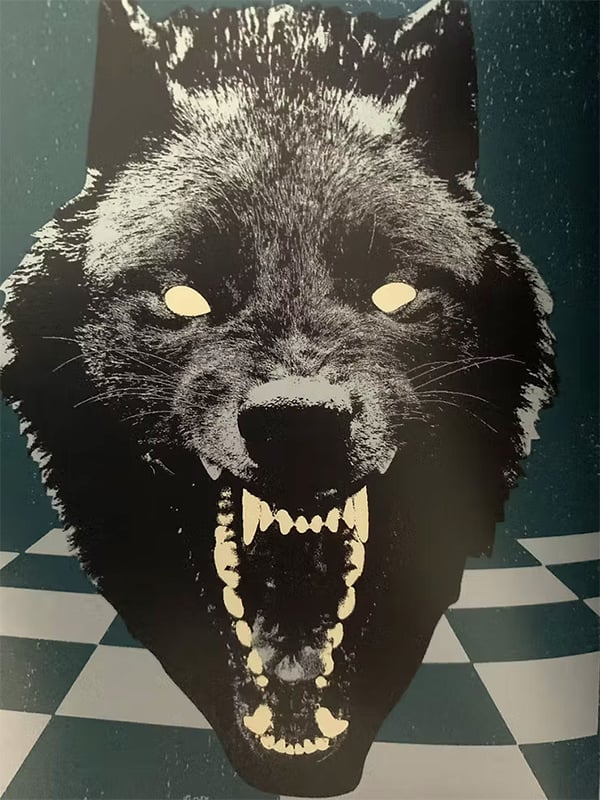
After a guard was literally frightened to death while walking along this passage, it was finally sealed up, and the spirit has not been seen since. It’s said that three nights before the guard died, he entered the passage alone. Unearthly screams were heard, and the man eventually staggered out white as a sheet and his eyes blazing with terror. Not a word of his ordeal escaped his lips, and soon after he died9.

“They say, that an apparition called, in their language, the Mauthe Doog, in the shape of a large black spaniel with curled shaggy hair, was used to haunt Peel Castle; and has been frequently seen in every room, but particularly in the guard-chamber, where, as soon as candles were lighted, it came and lay down before the fire in presence of all the soldiers, who at length, by being so much accustomed to the sight of it, lost great part of the terror they were seized with at its first appearance.”10
The Buggane of St Trinians
On the road from Douglas to Peel, you might have spotted the ruins of an old stone building off the road just before the Highlander. These are the remains of the 14th-century church of St Trinians where legend says that a Buggane ripped the roof off not once but three times. This Buggane was a shape-shifting creature said sometimes to look like a man and at others like a demonic black calf with tusks, flaming eyes, cloven feet, and sharp claws11.
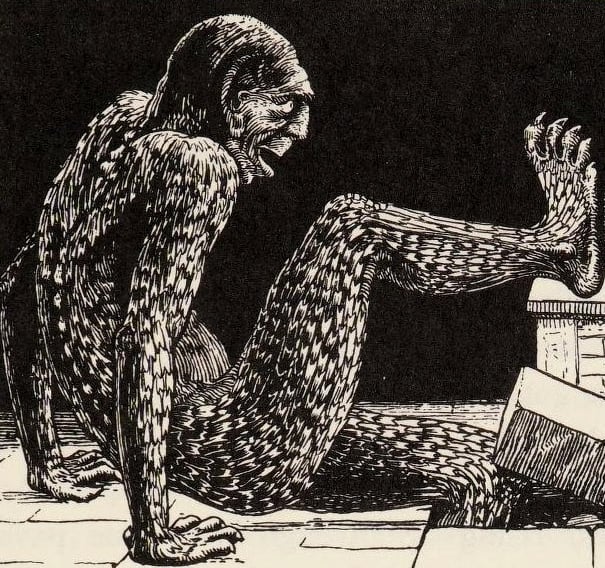
It’s told in a fairy tale12 that when monks built the church, the local Buggane decided he didn’t like the idea of ringing church bells disturbing the peace. He ripped the roof off in the night, and the next morning the people of Greeba discovered only broken beams and planks. The roof was rebuilt and yet again was ripped off as it had been before. The roof was put on a third time, and to show he had no fear of being had by a Buggane, Timothy the Tailor locked himself inside overnight.

In the wee hours, the Buggane emerged through a gaping hole in the floor and terrorised the man before chasing him to Marown churchyard. He couldn’t follow the tailor inside, so he ripped off his own head and threw it at Timothy.
The Chasms
On the coast between Port St Mary and Cregneash is a natural cloven-stone cliff accessible via a public footpath. The path leads down onto the formations, and you need to watch your step lest you take a fall down one of the fissures. It’s an incredibly beautiful spot, but watch your step! The combination of heights and deep drops makes this both spooky and slightly dangerous to walk through.

Also in the area is the abandoned Chasms cafe, which is eerie in itself, and Cronk Karran13, an ancient stone circle said to be either a burial or the outlines of a hut.
Witches Mill
Gerald Gardner, the father of modern Wicca, moved into Witches Mill and helped set it up as a witchcraft museum in the early 1950s. He came to the island from England and claimed that the Isle of Man was a centre of natural witchcraft and set about creating a coven and indoctrinating new members. Though there is no known historical link between witches and the mill, he perpetrated a story that the burned-out ruins of the mill tower had been used by witches since the late 19th century as a dancing ground14.

Among the displays at the museum:
“On the first floor are two rooms. One represents a Magician’s Study, of the period circa 1630, with everything set out for performing what is variously called Ritual Magic, Cabalistic Magic, Ceremonial Magic, or Art Magic; these terms mean very much the same thing, though some writers use one and some another. There is a large and complicated circle drawn on the floor, and an altar made to certain Cabalistic proportions. Beside it is the magician’s consecrated sword and behind it two columns, with light upon each. If used for good purposes only, this kind of magic was called White Magic; but if used for evil or selfish purposes, it was called Black Magic. The latter might involve the use of blood, and the summoning of demons, who were kept at bay by the Divine Names written around the circle, and were only permitted to manifest in the Triangle of Art drawn outside the circle, where they could be commanded to do the magician’s will.”14.
The museum closed in 1973, and the occult objects inside were sold off, with some of them now being owned by Ripley’s Believe It or Not15. The building itself was renovated in the 1990s into flats.
Gef the Talking Mongoose
One of the strangest and most famous tales to come out of the Isle of Man is that of Gef, the talking mongoose of Cashen’s Gap. The story began in 1931 at a remote farmhouse called Doarlish Cashen, near Dalby, where the Irving family – James, Margaret and their daughter Voirrey – claimed to have encountered a rather unusual visitor.
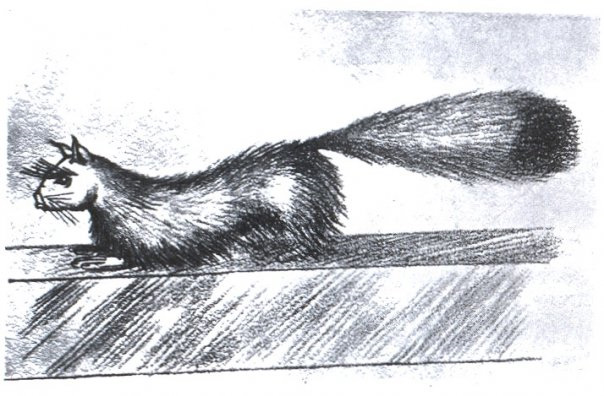
At first, they heard scratching and strange noises in the walls, but things soon took a much stranger turn when a small mongoose-like creature began speaking to them. Calling himself Gef (pronounced Jeff), he claimed to have been born in India in 1852 and described himself as an extra clever mongoose. He was said to be mischievous, chatty and sometimes rather rude, with an impressive knowledge of gossip, local happenings and even events taking place far beyond the farmhouse.
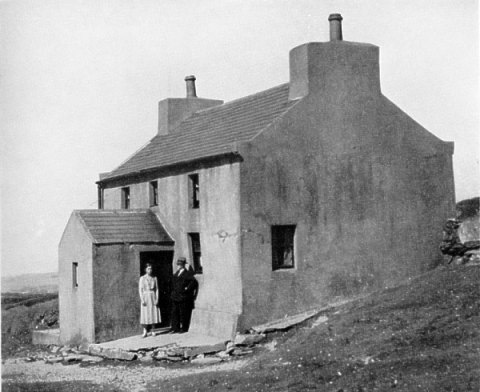
Gef became something of a sensation, attracting the attention of journalists, investigators and paranormal enthusiasts who travelled to the remote Manx farmhouse hoping to catch a glimpse of him. Some claimed to hear his voice, while others remained unconvinced, suggesting that the whole affair was an elaborate hoax involving the Irving family.
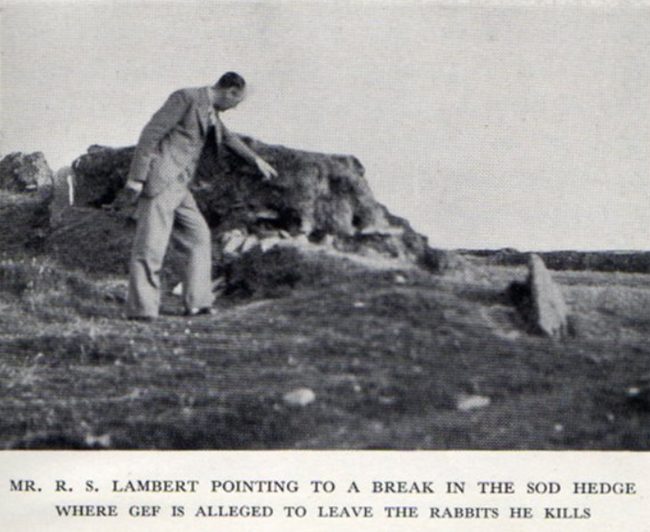
Despite searches of the property, nobody ever produced convincing physical evidence of the mysterious creature. The story eventually faded, and the Irving family left the farmhouse, but Gef remains one of the Isle of Man’s most peculiar legends. Whether he was a remarkably clever mongoose, a mischievous family invention, or something altogether stranger, the idea of a little creature chattering away inside the walls of a lonely farmhouse on the Manx coast is wonderfully eerie.
More Stories You’ll Enjoy
A HUGE thank you to Clare Barber, who shared many of these locations and some of the photographs. She took me on an amazing round-the-island tour to see some of them for the first time and take photographs. It was a scavenger hunt unlike any other and made me appreciate this Island’s history and stories even more.
- Carve Spooky Turnip Jack-o-Lanterns
- 15 Strange Places to Visit in the Isle of Man
- 12 Ancient and Neolithic Sites on the Isle of Man
- 14 Unique Things to do on the Isle of Man

1 Vampire Grave: the Vampire of Ellan Vannin
2 Modern Wicca: A History of Gerald Gardner to the Present
3 Smelt monument
4 Isle of Man Family History on the Cholera outbreak of 1832-33
5 Wikipedia on the Sea Lion Rocks Railway Station
6 Wikipedia on the Groudle Glen Railway
7 Report of the death of three young Prussian sailors by the Ramsey Courier
8 Wikipedia on black ghost dogs of Britain
9 Under the influence! Myths, legends, folklore and tales from around the world
10 George Waldron, History and Description of the Isle of Man (1st ed. 1731) 1744 edition, p.23
11 What is a Buggane
12 The fairy tale of the Buggane of St Trinians
13 Cronk Karran
14 Isle of Man Guidebook on the Witches Museum
15 Wikipedia on the Museum of Witchcraft and Magic
I am a little uneasy about the decision to include Summerland. As you say, it is still within living memory, and still brings up raw and angry emotions for many. Also, the remains you see are of the rebuilt complex subsequently demolished (not the one destroyed by the fire), of a different design to the original, but controvertial that it was rebuilt at all. Perhaps not really a topic to include along with legends of long ago that people can believe or dismiss, as they wish?
There’s also a place called The Ventre Center and when I went, we went in a coastal walk and the leaders told us ghost stories, one was about a lady ganging herself on her wedding day and another was about a man that used to come down to the venture center (it used to be a farm) to grind wheat and then one day, he got his head caught in the grinder and died! On the first night we stayed there, the boys in there dorms claimed to hear knocking on their door but when they checked to see who it was, no one was there!
Grim! Thanks for sharing Estelle!
Spooky note left as a FB message by Anne Sellwood: …the cry of the child who lived in the cottage gate of Lorne House Castletown who watched his mother hanged on the old field next to the ice house and down from the main House. I worked in Lorne House for 13 years, one of my projects was to convert the Court Yard, stables and Ice House into cottages. It was then I began to learn of the crying child, a boy. I think that the person who lived in the gate house at that time also heard the voice. There were many tales of Lorne House, one of which was the White Lady who walked the house – as far as I know nobody ever saw her so maybe that was just a phantom of someones imagination.
Hi. My Manx Grandad said he saw the White Lady, in Castletown, but I forget where. Somewhere near the Castle I think….
Spooky!
Spooky note told to me by a soap making student (Emma): Just now I was teaching a soap making class to a lady who used to work at the Isle of Man Bank in Laxey. There’s apparently the ghost of a woman at the top of the stairs there. Every woman who worked there avoided going upstairs there to use the ladies’ loo by instead using the mens’ in the basement!
So much fun. Now I’ll have to add it to the itinerary when I visit. :)
Hi I’ve actually seen a ghost in the theater when I worked there was on a Saturday morning in the foyer
What a scary experience that must have been! Do you know which of the Gaiety Theatre ghosts it was?