
12 Soap Design Ideas for Textured Tops
This article contains affiliate links. As an Amazon Associate, I earn from qualifying purchases.
Step-by-step techniques for creating amazing texture on cold process soap bars. Textured soap tops create visual interest and an artisanal feel, and you can make them using simple kitchen tools. Use spoons and spatulas to create peaks and valleys, chopsticks for swirls, and dried flowers and herbs. This piece on soap design ideas is from the new book The Natural Soapmaking Handbook by Simi Khabra.
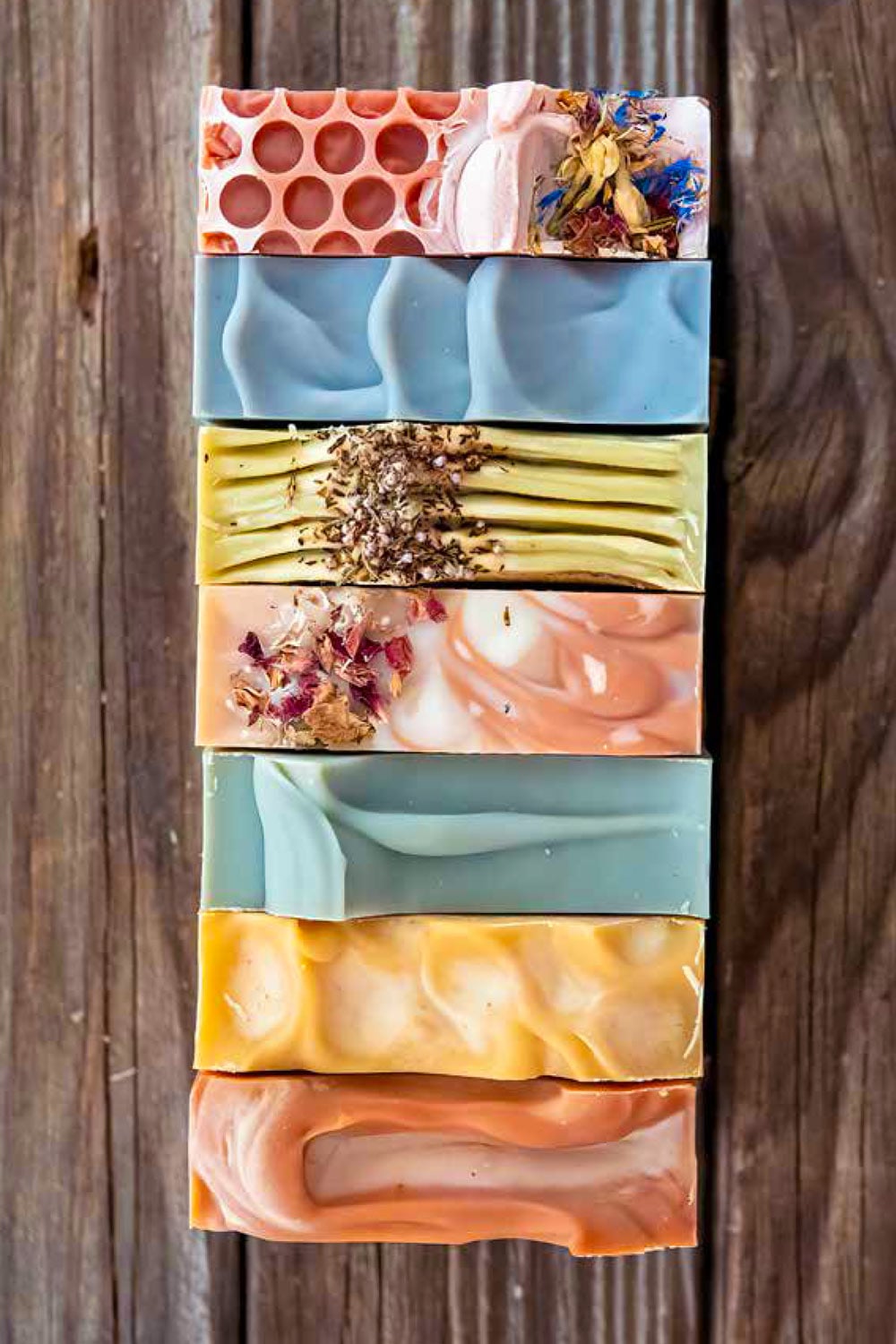
One of the most satisfying steps in the soap-making process is texturing the soap batter. It’s the finishing touch to your creation! It’s also a great opportunity to learn how your batter behaves in a particular recipe. While texturing can also happen in a soap, such as between two layers of color, texturing the tops of your soaps can really make your bar shine! It gives the bar a true artisanal feel, reminding the user that this soap wasn’t stamped out in a factory. It was handmade by someone who truly cares.
While some folks prefer a flat top, I like to have fun with my soap tops by creating volume and adding botanicals. This may not be your style, but I still recommend experimenting with it and seeing where it leads you. You may stumble upon something that you really love!
Soap Design Ideas Using Texture
Texturing tops is all about patience. Depending on your batter, you may have to wait for it to thicken so it’ll hold its texture. But if you wait too long, the batter might set up too much, making it difficult to texture. Remember that as soon as the lye water is blended with your oils, it starts turning into soap!

Some soap batters are a dream to texture, and others are more finicky. So testing the batter is the key to success. Grab your spoon and push a bit of the batter around. Is it holding its own or flopping back down? I like a nice thick batter to work with, but you might prefer something a bit thinner for a less dramatic top.
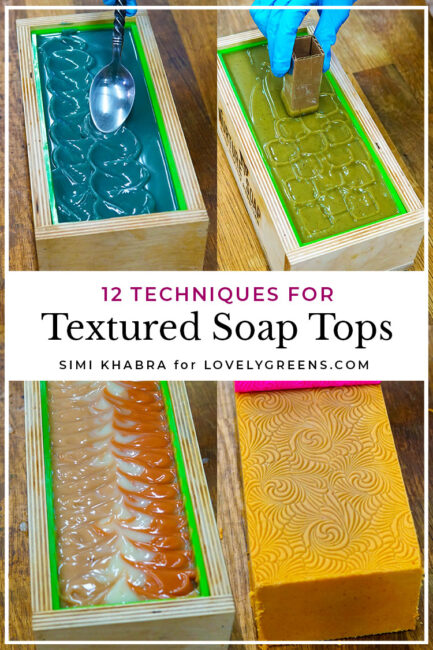
Remember that your texture doesn’t have to be perfect! Once you cut the bar, you only see a little slice of the top, so try not to stress about it. Have fun, experiment, and see where your tops take you! There are many ways to texture your soap tops, but these techniques are the most common and the ones I personally use the most.
Classic Spoon Texture
One of the best tools for creating textured tops is a simple spoon. With just one spoon, you can create a huge variety of designs and different textures. My trusty spoon is my go-to tool, and I use it for ninety percent of my soap tops. Make sure your spoon is stainless steel or plastic, as other metals can react with lye. I prefer using a teaspoon, but you can use any type of spoon you like.

Using the back of the spoon, push up the soap batter to create peaks and valleys. This will create volume on top of your soap. The thickness of your batter will make a big difference here. If your batter has set up a little more, the peaks will hold up and be taller. If your batter is still quite liquid, you’ll find that the patterns you make with your spoon fall flat.

Customizing the Spoon Texture
For a flatter top, you can still use a spoon for some light texture. Try running your spoon down the length of your soap to create a “river.” Keep playing around like this, and eventually, you’ll hit upon a texture that you love and end up using regularly. My signature texture for nearly all my soap tops has two swoops on each side and a divot along the top. This creates a bit of a mountain feel on the side of the bars when they’re cut.

Experiment with your spoon and see what happens! Maybe try twisting it, making a wave, or using the handle of your spoon for more detail. As long as your batter hasn’t set up too much, you can always “erase” your design. You do this by flattening out your top with a spatula or banging your mold on the table. Then, you can start again with a fresh canvas!
Spatula Swoops
Since you’re usually holding a spatula in your hand while making soap, many soapmakers use a spatula to texture their tops. When you’re in a hurry and your batter is setting up fast, this is a great option. A spatula can function exactly like a spoon, except it creates a wider design.

One of the easiest spatula designs is made by creating swoops in your batter. Use the edge of the thickest part of your spatula to drag the batter from the sides to the middle of your loaf. Leave it like this for an asymmetrical design. You can do the same thing on the other side for a symmetrical look.
A spatula allows you to use a variety of widths, depending on how much of the spatula you lay in your batter. You can use the tip of the spatula to add more detailed swoops. Alternatively, you can smooth everything down with your spatula for a nice flat top.
Like the spoon texture, there are so many possibilities here. Just remember that when you cut your soap, each soap bar will only show a portion of the overall design!
Honeycomb Top
The best-kept secret of soapmakers is how they make their honeycomb tops! This is a great texture to use when making honey-themed soaps. The secret is bubble wrap! Cut a piece of bubble wrap in the shape you’d like ahead of time by measuring it along the top of an empty soap loaf mold.
Bonus: It’s very satisfying to remove the bubble wrap! Try adding bubble wrap to only half the width of your bars for an even more interesting texture.

Once you’re done pouring your batter, wait until it’s a little on the thicker side, and then gently lay the bubble wrap on top. Using gloved fingers, press down gently on the bubble wrap to ensure it’s evenly spread over the top of your soap. Leave it there until you unmold your soap the next day. Upon removing the bubble wrap the following day, you’ll notice that the bubbles created little indents in the soap that look like honeycomb.

By the way, not all bubble wrap is created equal. Some bubble wrap has much more defined bubbles than others. That’s the kind I like to use, but the flatter bubble wrap will also work just fine. Once you’re done using your bubble wrap, you can soak it in a bucket, wash it up, and use it again next time. We’ve used the same bubble wrap on our honey soap for over two years!
Impression Mats for Texturing Soap Tops
Impression mats are very similar to the bubble wrap technique, except you’re using a mat made from silicone that has a design on it. Silicone impression mats are typically used for baking, so they’re widely available in all kinds of designs.

Like the honeycomb technique, you simply cut your mat to the required size for your mold and gently place it on top of your soap. Press it down carefully to ensure the pattern is picked up, and let it sit on top until you’re ready to unmold. Once your soap has hardened up, peel the impression mat back to reveal the design underneath!
12 Soap Design Ideas for Textured Tops
Some soapmakers will place their mat at the bottom of the loaf mold. There are a few advantages to this technique, especially if the mat is very detailed in its design. Placing the impression mat at the bottom allows the most liquid part of your soap batter to flow onto the mat. This ensures the impression is properly picked up.

If your batter is thicker, you can push it down with a spatula onto the mat. If you want a very detailed design with varying colors, it’s easier to put the mat on the bottom and work on it carefully first. Then pour the rest of your soap on top. Remember that if your impression mat is at the bottom of your mold, the top of your soap will end up being the bottom of your bars! When you get to the top, you’ll want to ensure the tops are nice and flat so your bars will stand properly.
Striped Colors
When working with multiple colors in your soap, you have an opportunity to make a beautiful soap top. If you save a little bit of each color for the end, you can lay down the color in stripes on top of your soap. You’re welcome to leave it like that, but you can also use a chopstick and run it in the opposite direction of your stripes. This creates a beautiful chevron-type design reminiscent of cake tops!

Once you see how the stripes interact with each other, you’ll start to see the possibilities. Using swirls, concentric circles, or figure eights will also lead to lovely designs on top. Especially when you have a variety of colors to play with.
Crosshatch Pattern
One of the simplest stamped designs is a cross-hatch pattern, which you can make with your spatula. Hold your spatula in your hand with the end straight up and down. Place the edge of the spatula straight down into your soap top and pull it straight back up. You’ll only be going through the very top layer of batter, as you don’t need to go deep to make this design.

This will create a raised line on top of your soap. For a crosshatch, create diagonal lines across the top of your soap in one direction and diagonal lines in the other direction. This will create diamond-shaped spaces between the lines, resulting in a crosshatch pattern!
Chopstick Swirl
This design allows you to create a flat-topped soap but with a little more interest and an elegant feel. The key to the chopstick swirl is to wait until your batter is thick before you go in with your chopstick. You can use a chopstick for this design, as the name implies. You can also use a bamboo skewer (that’s what I use) or any other object that’s long and skinny.

Once your batter has set up a bit, take your chopstick and swirl it around in small circular strokes or figure eights. See what it does to the batter, and once you have a rhythm you enjoy, cover the entire loaf of soap with your design. You can go in and correct areas or make the swirls a little more dramatic so the batter stands up a bit. If you want an even more subtle look, try the chopstick swirl with a thinner batter.
Stamped Designs
One fun technique with soap tops is to “stamp” a design right on the top! If you’ve played with soap batter a bit, you’ll notice that if it’s on the thicker side, it’ll hold an imprint quite well. The idea with this technique is that you can use an object to stamp the top, and when you pull that object out, the batter will raise a little to create a design. You could use a small cookie cutter for this, or anything you find.

Many soapmakers make their own stamps, either with wire or cardboard, to create a custom design. A simple overlapping square design is always a nice choice. With the object you’d like to imprint in your gloved hand, bring it down just a little bit into the soap batter and then pull it out. Feel free to overlap the stamps for a more interesting pattern. Continue to do this on any part of your soap top that you’d like to stamp. When the soap hardens up, the pattern will remain on the top.
Beautiful Botanicals
Botanicals add that pop of interest and color that can really draw the eye. I’m a huge fan of adding a little bit on top to give visual interest and also give the user a glimpse of the ingredients inside the bar. For example, I typically use lavender buds on lavender soaps or dried peppermint on mint soap, but you don’t always have to follow these rules.

Flower petals are a great option on soap tops, although be aware that they can turn brown depending on the climate in your area. I love using rose, calendula, and cornflower petals. Jasmine and heather flowers are lovely as well. I prefer to err on the side of “less is more,” but you can cover your entire soap top if you like! Remember that the things you put on top of the soap will likely go down the drain. Keep this in mind before you go too crazy with the tops!
In addition, some botanicals like juniper berries or larger flowers are difficult to cut through, which may be an issue when cutting your soap loaves. You can get around this by marking your loaf mold to show the cut lines. That way, you can see where the loaf will be cut and ensure you place the botanicals in the middle of the bars. More on using herbs and dried flowers in soap making.
Decorating Soap Tops with Flowers
Before you begin making your soap, gather up any botanicals that you might want to use on top. This will allow everything to be ready to go, so you don’t need to search for botanicals while your top is hardening up! With gloved hands, sprinkle your botanicals in the desired location. Keep adding botanicals and layer them up, if needed, until you like the results.

Once you’re done, use the end of a chopstick or your gloved finger to gently press the botanicals into the soap. Don’t press hard at all! You just want to make sure the botanicals don’t fall off when you unmold and cut your soap. You’ll still lose botanicals when cutting your soap, but this will prevent most of the botanicals from falling off.
Another popular addition to the tops of soaps is salt. Pink Himalayan salt or black Hawaiian salt can really lend a spa-like feel to your soaps. Just remember that salt is a humectant and may attract moisture, so if you live in a humid climate, it may not be the best option.
More Textured Soap Tops Inspiration
Other tools you can use to create textured soap tops are butter knives, whisks, a fork, or nearly anything else you have lying around. Get creative! Many soapmakers are phenomenal artists and create very elaborate and detailed tops.

This can include “frosting” your soap top using a piping tip or making small objects out of soap (like soap berries) to add to the tops. You can even buy or make your own soap dough. It can be manipulated just like clay to make intricate designs that can be added to the tops of your soap. The options are endless!
This article is an excerpt from The Natural Soapmaking Handbook, a new soapmaking book by Simi Khabra. The book includes many natural soap recipes and invaluable techniques for making handmade soap. You can find Simi on Instagram, Facebook, YouTube, and her blog, but do make sure to pick up a copy of her book, too! If you enjoyed this piece, you might also want to check out these other soapmaking pieces on Lovely Greens:
- Guide to Using Herbs and Flowers in Soap Recipes
- Essential Soapmaking Equipment and Tools
- How to Naturally Color Soap
Credit: Reprinted with permission from The Natural Soapmaking Handbook by Simi Khabra. Page Street Publishing Co. 2024. Photo credit: Simi Khabra.
beautiful, thanks!