
How to Formulate a Soap Recipe (cold-process)
This article contains affiliate links. As an Amazon Associate, I earn from qualifying purchases.
Learn how to formulate a soap recipe from scratch using oils, fats, lye, and soap additives. You’ll be guided through different ways to create soap recipes and learn how to use an online soap calculator. This guide focuses on natural cold-process soap recipes, but it also includes tips for hot-process recipes.


The first rule in formulating a soap recipe is that you can use practically any vegetable oil or animal fat to make soap—olive oil, coconut oil, and tallow, to name a few. However, creating a good soap recipe takes practice. With that skill comes learning to work with different ingredients and choosing the right balance of oils, plus the right amount of lye, water, and additives.
I will walk you through the main things you need to know as you start creating natural soap recipes. They include choosing oils, making recipes more affordable or sustainable, and creating the best soap recipe for your purposes.
I have plenty of soap recipes for you to use; however, formulating your own gives you far more flexibility and customization. It also lets you make soap on a budget, align with your ethos, or cater to allergies or a specific target market. You can also create custom recipes that are entirely your own!
What Are Soap Recipes
Soap recipes are chemical formulas that transform everyday oils and fats into soap bars. They always include fatty oils, water, and lye, and may also include soap additives such as soap colorants, essential oils, herbal infusions, and botanicals.

Soap recipe ingredients are listed by weight, with metric grams as the most common unit (Americans sometimes use ounces). When measuring soap ingredients, you must use a digital kitchen scale. If you use all-natural ingredients in the right quantities, your formulas will create gentle, natural soap.

You can make soap using either the cold process soap making method (CP) or the hot process (HP) method. Think of them as two ways to help you make the same soap recipe. The main difference between CP and HP soap recipes is the amount of water needed. The processes may differ, but you still need a stick blender for both, along with other equipment like eye protection, gloves, goggles, and more.

A fun experiment is to use the same recipe to make a batch of soap using either method. You’ll then see how similar and different both methods are! Because of these differences, finished hot-process soap can often look more rustic than cold-process, but not always. It’s fundamentally the same type of soap, though.
How to Formulate a Soap Recipe
When formulating a new soap recipe, start with a specific function or ingredient in mind. For example, you might want to make a gentle facial soap, or you have local honey that you’d like to use to make honey soap. This brainstorming phase also helps you check ingredient availability in your area and the best prices for oils and additives. You can also use this time to research ingredients suited to your intended formulation and their ideal usage rates.

Once you’ve completed this legwork, it’s time to get into the nitty-gritty of formulating. Soap recipes are natural chemical formulas and should be adhered to as closely as possible. They include specific ratios of oils and the precise amount of lye needed to turn most of the oils into soap.

Many soap makers use online soap calculators to formulate their soap recipes. However, they are only helpful if you know the principles of good formulation. We use three methods to calculate formulas: a general ratio method, fatty acid percentages, and considering recommended oil percentages. I use all three methods when formulating my soap recipes.
Single Oil Soap Recipes
Before we get to that, I’d like to touch on a common question in soapmaking: Can you use just one oil to make soap? You can, but only a few oils/fats can be used alone to make good soap. The best single-oil soap recipes are Castile soap, made from 100% olive oil, and tallow soap, made from 100% beef fat. Another is 100% coconut oil soap.

Most soap recipes with just one oil/fat end up being too soft, too hard, too slimy, too cleansing, or have some other downside. Even Castile soap, an excellent soap, needs six months to a year to cure before it’s ready to use. Before this time, the lather is slimy, and the soap can have low cleansing. That’s why most soap recipes include several oils. Each oil brings different qualities to handmade soap and creates a much better result than using just a single type of oil.
Simple Soap Formulations
The most popular soap recipes use common, affordable oils that make good soap. They are usually simple recipes that make good all-purpose soap for daily washing. If you’d like a little help creating your soap recipes, here are some basic formulations to start with. They list only the main soaping oils and provide their percentages as a total of all oils used by weight. You would typically make them with a 5% superfat and a 33% lye concentration—almost the same as a 2:1 water-to-lye ratio.

- 30% coconut oil, 30% sustainable palm oil, and 40% olive oil
- 35% olive oil, 25% babassu oil, 15% shea butter, 15% cocoa butter, and 10% castor oil
- 70% olive oil, 25% coconut oil, and 5% castor oil
- 60% lard or tallow, 20% coconut oil, 15% high-oleic sunflower oil, and 5% castor oil
Saturated to Unsaturated Fat Ratio
The simplest way that soap makers formulate simple soap recipes is by following a ‘sat:unsat’ ratio. Many are calculated at around 50:50 saturated-to-unsaturated fat, and they tend to include an average of four to six different oils. This ratio can vary by soap maker, with some preferring 40:60 or 60:40, or something in between. Using the ratio method helps create soap recipes with relatively balanced qualities of hardness, longevity, conditioning, lather, and cleansing.

To clarify, saturated fats are typically “hard oils” solid at room temperature, and unsaturated fats are usually “soft oils” that are liquid at room temperature. Popular saturated fats in soap recipes are coconut, tallow, sustainable palm, palm kernel, and babassu oil. Common unsaturated fats include olive oil, sunflower oil, canola oil, avocado oil, and rice bran oil.

This basic approach to a soap recipe works for many soap-making oils, but not all. For example, castor oil, an unsaturated fat, is typically used at only 5-10% of the oils. Using more than this can make the finished soap too soft and sticky.

Too much coconut oil can leave your skin feeling tight and over-cleansed. Too much sunflower oil can cause soap to go rancid quickly. Then you have solid oils like shea, cocoa, and mango butter, which mix saturated and unsaturated fats. They don’t neatly fit into one category or another.
The general ratio principle helps when creating a rough recipe draft. However, you need to refine it by looking at ideal oil and fatty acid percentages in soap recipes.
Ideal Usage Rates of Oils in Soapmaking
As mentioned, few oils can make good soap on their own. Most soap recipes include four to six oils, each bringing different qualities to the finished bars. However, each oil has an ideal usage rate in soap, providing the qualities you want without downsides. For example, using too much ordinary canola or sunflower oil can make soap bars go rancid and develop dreaded orange spots (DOS). Using too much coconut oil can make soap feel overdrying.
| Oil/Butter | Main Fatty Acids | Soap Qualities | Ideal Usage Rate |
|---|---|---|---|
| Olive Oil | Oleic | Very conditioning, low lather, long-lasting | 30–60% |
| Coconut Oil | Lauric, Myristic | Cleansing, bubbly lather, hard bar | 15–25% (max 30%) |
| Palm Oil | Palmitic, Oleic | Hardness, creamy lather, stable base | 20–30% |
| Castor Oil | Ricinoleic | Lather booster, conditioning, sticky in high % | 3–8% (max 10%) |
| Shea Butter | Oleic, Stearic | Conditioning, creamy, adds hardness | 5–25% |
| Cocoa Butter | Stearic, Oleic | Hardness, stable lather, conditioning | 5–20% |
| Avocado Oil | Oleic, Palmitic, Linoleic | Conditioning, mild, nourishing | 5–20% |
| Sweet Almond Oil | Oleic, Linoleic | Conditioning, silky feel, mild | 5–15% |
| Sunflower Oil | Linoleic, Oleic | Light conditioning, soft bar | 5–15% |
| High Oleic Sunflower Oil | Oleic (75–90%), Linoleic (low), Palmitic | Very conditioning, stable, resistant to rancidity | 10–40% |
| Rice Bran Oil | Oleic, Linoleic, Palmitic | Conditioning, mild, may soften soap | 5–20% |
| Lard | Oleic, Palmitic, Stearic | Hardness, creamy lather, conditioning | 30–50% |
| Tallow | Oleic, Palmitic, Stearic | Hard, creamy, stable bar | 30–50% |
| Mango Butter | Oleic, Stearic | Hardness, silky texture, light conditioning | 5–15% |
| Canola Oil | Oleic, Linoleic | Conditioning, softer bar, short shelf life | 5–15% |
| Grapeseed Oil | Linoleic, Oleic | Light, soft bar, oxidizes easily | 5–10% |
Formulate a Soap Recipe by Fatty Acid Percentages
You can create good soap recipes by looking at hard-to-soft oil ratios and ideal usage rates per oil. However, experienced soap makers also formulate by looking at the fatty acid percentages in a soap recipe. All oils are created from bonds of different fatty acids—think of them as molecular links in a chain that creates oils. I’ve listed the main fatty acids that you’ll find in specific oils in the above chart. The chart below shows the ideal percentage of fatty acids in soap recipes and what each contributes.
| Fatty Acid | Soap Qualities | Ideal % in Recipe | Oils High in this Fatty Acid |
|---|---|---|---|
| Lauric | Hardness, cleansing, bubbly lather | 10–25% | Coconut oil, Palm kernel oil, Babassu oil |
| Myristic | Hardness, cleansing, bubbly lather (milder than lauric) | 2–8% | Coconut oil, Palm kernel oil, Babassu oil |
| Palmitic | Hardness, creamy/stable lather | 5–15% | Palm oil, Rice bran oil, Lard, Tallow, Cocoa butter |
| Stearic | Hardness, creamy lather, long-lasting bar | 5–15% | Shea butter, Cocoa butter, Mango butter, Lard, Tallow |
| Ricinoleic | Lather booster, humectant, sticky in high % | 3–10% | Castor oil only |
| Oleic | Conditioning, moisturizing, gentle lather | 25–40% | Olive oil, High oleic sunflower, Avocado, Sweet almond, Lard |
| Linoleic | Silky conditioning, soft bar, prone to rancidity (DOS) in high % | 5–15% (with care) | Sunflower (regular), Safflower, Grapeseed, Rice bran, Canola |
| Linolenic | Light conditioning, short shelf life, DOS risk in high % | <2% | Flaxseed, Hemp seed, Canola (to some extent) |
Fatty Acid Information in Soap Calculators
When formulating with an online soap calculator, it should provide the fatty acid percentages for each oil and the entire recipe. I use this free soap calculator, and you can find this information both on the formulation screen and in the final recipe formula. Despite this, most beginner to intermediate soapmakers fixate on the ‘Soap Bar Quality’ section because it seems easier to understand.

However, the fatty acid percentages are the most crucial information. Too much linoleic or linolenic acid can cause your soap to go rancid quickly. Too much oleic acid may make the soap very soft or slimy when used. Ricinoleic acid in amounts over 10% can make the soap soft and sticky.
You don’t have to stay strictly within the ideal ranges, but beginners should until they understand what pushing the boundaries can do.
Using Fine, Exotic, and Expensive Oils to Make Soap
When beginner soapmakers use online soap calculators, they often get excited over the sheer number of oil selections. There’s meadowfoam oil, rosehip oil, hazelnut oil, and dozens of others! My advice to those formulating is to proceed with caution. These oils are often expensive and, in some cases, heat-sensitive or high in linolenic or linoleic acid. Both can potentially cause rancidification and funky smells in your soap.

That happened to me when I tried hemp seed oil in my soap. In weeks, my soap went from lovely to smelling like oil paints. It was very disappointing and such a waste. If you have fine oils, I usually recommend saving them for leave-on skincare products, such as skin cream or body butter. It’s better not to use them in soap making.

If you are sure you want to use a certain oil, make sure that it has a purpose in the soap. For example, neem oil soap suits those with eczema and psoriasis. Another thing to consider: in cold process soap making, most of the fine oils you use will become soap—the superfat will be a mixture of all the oils in the recipe. In hot process soapmaking, you have more control over the superfat. You can add a specific oil after the main soaping oils are cooked and fully saponified.
Calculating Superfat
Superfat is a simple but often misunderstood concept. When we formulate a personal care soap recipe, we want it to cleanse without stripping our skin. To achieve this, we include enough lye to fully transform the oils/fats we use into soap, but not enough to saponify all of them. The extra oil left in each bar of soap is called the superfat.

Typically, we set our superfat level at around 5-7%, meaning 5-7% of the original oils stay in the bar as they are and don’t become soap. I usually don’t use more than 6% superfat in my recipes, and I find 5% is plenty. It’s enough to give soap lovely conditioning, but not so much that it affects lather, the hardness of bars, or increases the chance of DOS.

Other soapmakers have different opinions and experiences, and some push the limits up to 10% or more. Some recipes call for no superfat, such as when making solid dish soap recipes. The reason being that any residual oil in the soap can leave streaks and residue on your dishes, cutlery, and glassware.
How Much Water to Use in Soap Making
One of the biggest questions I get about my natural soapmaking recipes is why my water amounts are different from the suggestions in soap calculators. Many people are surprised to learn that the amount of water (or water-based liquid) you use in soap recipes can vary. Each soapmaker will eventually have their preferences.

Soap calculators commonly set the default water amount at 38% of the weight of the soapmaking oils. This amount can make cold-process soap, but it will trace more slowly, gel faster, and cause your bars to shrink during curing. It’s a better amount of water for hot-process soapmaking because the water evaporates as the soap cooks.

For most simple cold-process soap recipes, I either set the lye concentration at 33% or double the lye amount (2:1 water to lye) to get the water you need—both give you roughly the same result. I only use more water than this when I want more time to work with the soap batter. However, using more water can increase the chance of getting soda ash on the soap or issues like glycerine rivers or volcanoes.
The bare minimum amount of water you can use in soap recipes equals the weight of the lye. That’s a 50% lye concentration, and it makes the soap trace faster and less likely to gel, especially in non-loaf soap molds.
Calculating Soap Additives
Though some soap calculators include options for fragrance and soap additives, I ignore them. I don’t trust them to be accurate. Many fragrance oils (not natural) may have the same usage rates, but that’s not the case for essential oils. There are also many essential oils, such as ylang-ylang essential oil, with IFRA differences between manufacturers and essential oil types. I have guidance on how much essential oil to use in soap and encourage you to work it out manually, too.

Most other soap additives come in variable amounts you can use in soap recipes. With many, you use a little, and you’ll get a small effect. Use more, and you’ll have a bigger impact. That includes exfoliants, natural colorants, and herbs and flowers.
Finding the right balance between skin safety, desired effect, and avoiding additives that impede lather and cleansing is part of learning to formulate.
Using a Soap Calculator
Each online soap calculator, also called a lye calculator, is different, but they share the same core function. In essence, a soap calculator helps you see fatty acid percentages, formulate a safe, good soap recipe, and resize soap recipes.

It’s also crucial for calculating how much sodium hydroxide you need to make a batch of soap (or potassium hydroxide if you’re making liquid soap). After formulating with a soap calculator, you can save or print a soap recipe. I tend to print them out and keep the recipes I want in a notebook.
Using a Soap Calculator
If you’ve read this far, you’ll now know that there are three main ways to formulate a soap recipe. You’ll also know that soap calculators help you formulate rather than create formulations for you. You can use them to set the superfat, control the amount of water in a soap recipe, and see whether your recipe is balanced and will work before you even make it.
Soap calculators don’t create soap recipes for you—you use them to help you formulate. That means you manually add in the oils you want, the percentages (or weight) you want to use, and the type of lye and the batch size you want. What it does is helps you see the fatty acid balance of your recipe, other soap qualities and how much lye and water to use in a recipe.

Many soap calculators are either paid-for services or created by companies that sell soap ingredients—I rarely dabble with those. Instead, I use this free soap calculator. The interface is basic and there’s a lot of information displayed, so I wanted to point out the main ways I work with it. It has eight numbered areas that you work with:
1. Lye Type
The first area is where you select NaOH (sodium hydroxide) to formulate a cold-process soap recipe. The other selection, KOH (potassium hydroxide), is for making liquid soap.
2. Measurment Units
The second area lets you choose your weight measurement. I recommend that you stick with grams since its increments on digital scales are smaller than ounces/pounds. Grams help you create more accurate soap recipes, especially for small batches. You can also set your batch size here—the smallest batch size I recommend is 454 g (1 lb).
3. How Water is Calculated
The amount of water called for in soap recipes is relatively flexible. In the 3rd section, you choose how the water amount in your recipe is calculated.
The option for calculating water as a percentage of oils is old-fashioned and not as good as the other two. I don’t use it.
The second option in this field is ‘lye concentration.’ Using this selection will calculate the water amount of your recipe to create a certain strength of lye solution. I tend to use this option and for most simple soap recipes, I use 33%. That means that lye makes up 33% of the lye solution, with water making up the other 67%. With this way of measuring, the highest you can go is 50% (50% lye and 50% water), and the lowest is 25% (25% lye and 75% water), but there’s very little reason to go that high or low.
The third option is ratio of water to lye. This option also helps you create standard lye concentrations but in a more physical way. For example, a 2:1 ratio is a common ratio that soapmakers use when making lye solutions. It means that for every 1 part lye, you would have 2 parts water. So, if the lye needed for the recipe is 100 g, the water amount would be 200 g.
4. Superfat
You choose the superfat level in your soap in part four. 5% is usually a great superfat level for most soap recipes. Don’t go crazy here since higher superfats can sometimes cause performance and longevity issues. I also completely ignore the fragrance field in this area. I work out how much essential oil to use manually.
5. Fatty Acids
Section five displays fatty acids and oil types. Click an oil to see its fatty acid percentages. Double-click an oil to add it to the soap recipe oils section in section six. Other fields are here, too, but they won’t display information until you finish the next section.
6. Oils and Fats
Your oil formulation appears in section six. Use the radio buttons to select whether the amount of that oil will be calculated by percentage or by weight. For example, if you want to make a recipe with 100% olive oil, you would select percentages. If you only have 500 g of olive oil left and want to use it up in a batch of pure olive oil soap, you’d use the other radio button.
7. Calculating and Loading Buttons
Once you’ve added all your oils in section six, press ‘Calculate Recipe’ in section seven. Then, you can see the saturated-to-unsaturated ratio back in section five (it’s at the bottom). You can also see the complete fatty acid percentages of the entire recipe in section five. It’s in the second column, ‘All’. When you’re happy with the recipe, press the button ‘View/Print Recipe button.’ The screen that comes after this shows you how much lye and water you need for the recipe.
8. Save and Load Recipe
Easy to overlook, the buttons in section 8 help you save and load recipes. I don’t use them.
Beginner Soapmaking Course
If you’re ready to go with formulation, I hope this piece has been helpful. If you’re feeling a bit bewildered and just want to try making a dependable recipe, I have good news. Here on Lovely Greens are many easy soap recipes that you are welcome to use. Most are print-friendly and can be scaled so that you can make double or triple the amount at a time.
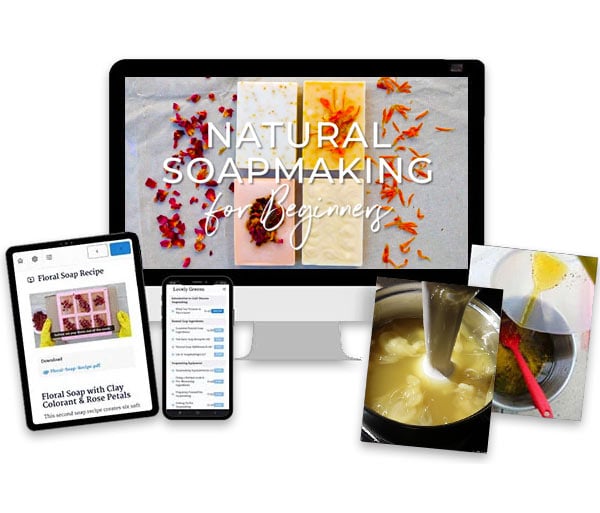
And if you need a bit more guidance and reassurance, I’m here to help. In the Lovely Greens online soapmaking course you’ll learn everything you need to know to get started. It’s a video-course with me walking you through equipment, safety, ingredients, and setting up your soapmaking station. I then lead you step-by-step through making different soap recipes, which you can print out. The course helps you learn the basics of making soap and build your confidence!