
Homemade Calendula Cream Recipe
This article contains affiliate links. As an Amazon Associate, I earn from qualifying purchases.
Use natural ingredients to make this step-by-step calendula cream recipe. It contains skin-soothing calendula oil, nourishing cocoa butter, and sweet-scented rose hydrosol. The recipe includes full instructions, a DIY video, and explanations of each ingredient.
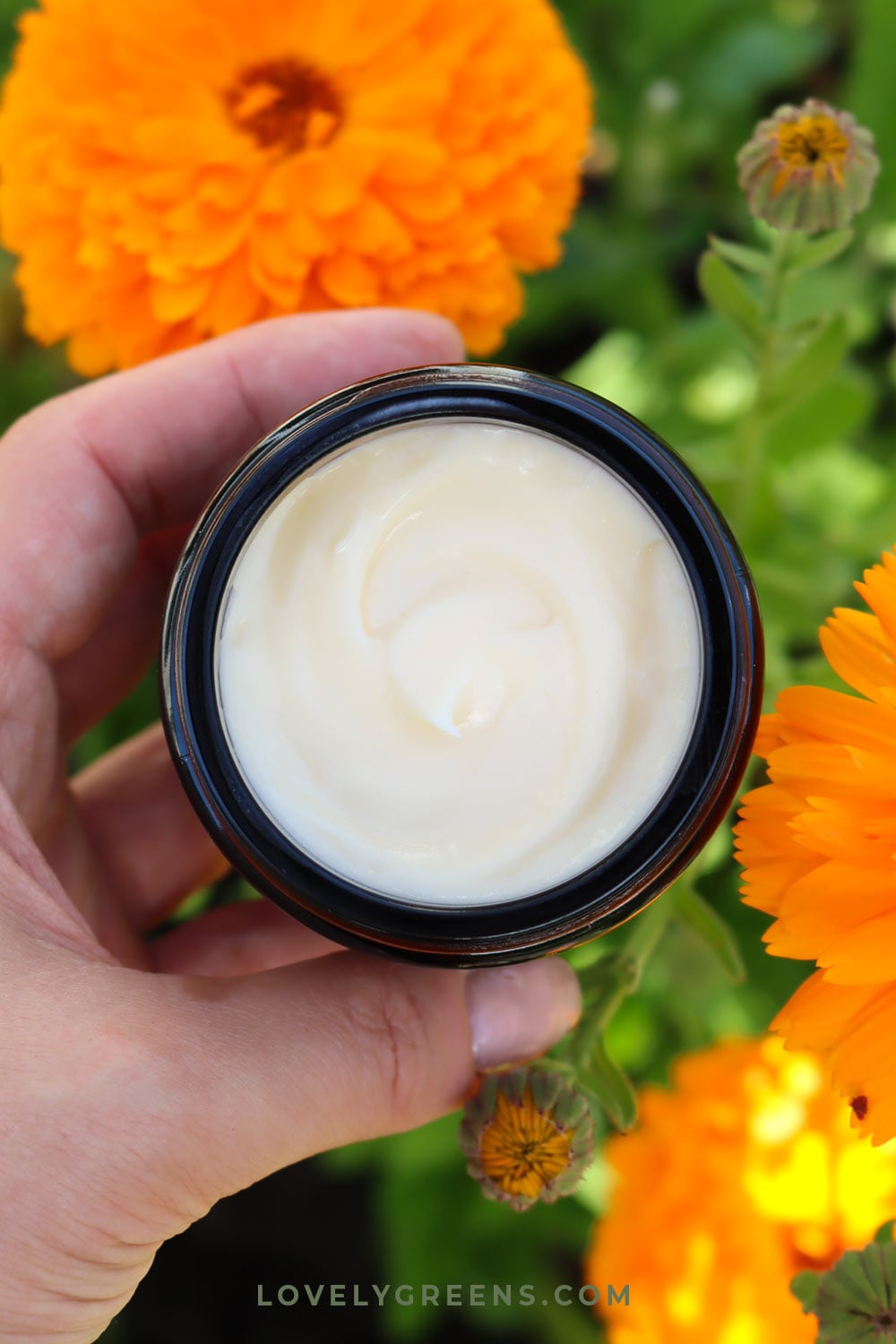

If there’s one skincare plant that I can recommend, it’s calendula. Many people grow it as a companion plant, an edible flower, or for herbalism, but it’s also used in herbal skincare. The flowers are rich in compounds traditionally used to promote healing and infuse your skin with antioxidants. I think that makes it the perfect ingredient for making a nourishing hand and body cream recipe.
The recipe begins with dried calendula flowers. You infuse them in a carrier oil of your choice to create calendula herbal oil. Then mix it with other ingredients to create a true, stable emulsion. This medium-thick skin cream is wonderful for dry skin and inexpensive to make yourself.
Calendula Cream Ingredients
This calendula cream recipe includes several ingredients, starting with calendula oil. Herbalists use the healing properties of calendula flowers to speed skin healing and soothe inflammation 1. It’s a common ingredient used in salves and ointments for treating minor wounds, eczema, scrapes, bruises, sunburn, diaper rashes, and bug bites. Be aware, though, that calendula can cause allergic reactions and skin irritation in those with Asteraceae (ragwort) allergies 2.
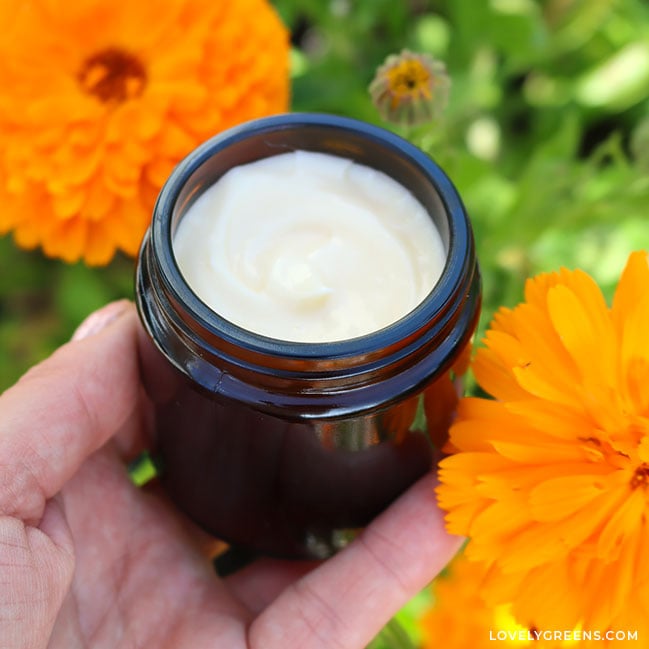
The other ingredients include essential oil for scent, vegetable glycerine for moisture, and beeswax to help lock the cream into your skin. There’s also an easy-to-use emulsifying wax, a preservative approved for organic skincare, and a delicate floral water to add extra moisture and soothing properties.
Rose Hydrosol for Hydration
Handmade lotion and skin cream are mixtures, called emulsions, made with water (or a water-based liquid) and oil. Oil can be a carrier oil like sweet almond oil or an ingredient that needs melting, such as cocoa butter. While the oil in the cream helps condition and can carry active constituents, the water moisturizes your skin. The water in a cream recipe can be distilled water, aloe vera juice, and floral waters. In this calendula cream recipe, the water-based liquid is a floral water called rose hydrosol.

It’s a naturally clear, rose-scented ingredient made by distilling rose petals. It not only smells beautiful, but it is also used in skincare and by herbalists to calm inflammation, firm the skin, and promote hydration. Most of it is in the water phase, but a little is used in the cool-down phase, too.
Homemade Calendula Infused Oil
The foundation of this calendula cream recipe is a simple carrier oil infused with dried calendula flowers. This calendula oil acts as an emollient in your lotion and contains active ingredients from calendula flowers. Though you can buy it ready-made, it’s easy to make calendula oil year-round! All you need is dried calendula flowers and a carrier oil. You can use a quick method to make homemade calendula oil in hours, or a traditional method that takes several weeks.
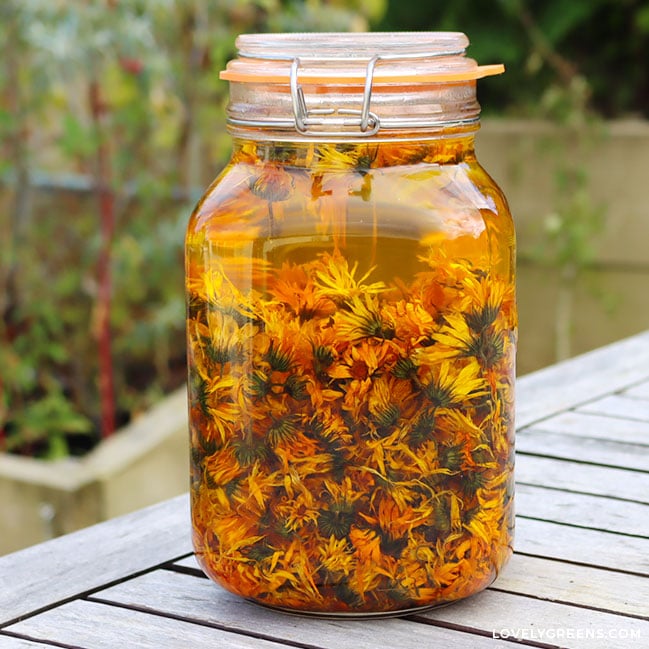
The carrier oil used to make calendula oil can have different properties based on which one you use. Oils can add different levels of conditioning, vitamins, and feel. Lighter oils, such as sweet almond oil or apricot kernel oil, are ideal for many skin cream recipes because they absorb faster. If you have dry skin and need more nourishment, you might consider avocado oil, olive oil, or jojoba oil. For this calendula cream recipe, you can use any carrier oil, so the choice is yours.

Most of the time, you’ll never know which variety of calendula flower you get when you buy calendula. I’ve never seen this information listed. However, if you grow your own, you’ll know exactly which type it is and can control how it grows and is harvested. For skincare recipes, I grow calendula ‘Erfurter Orangefarbige’, then harvest and fully dry it before making calendula oil. I take you through other varieties high in skin-beneficial compounds in how to grow calendula.
Using Fresh Calendula Flowers
I often get questions about making calendula oil with fresh flowers. I don’t recommend it because fresh flowers contain quite a bit of moisture. That tiny amount can contribute to early rancidity (oxidation) in the finished calendula oil, leading to an off-putting scent and a much shorter shelf life. Fresh flowers also mold over if they’re allowed to float to the surface of the oil.

Although I’m not aware of a specific scientific study, I also suspect that calendula oil made with fresh flowers might not be safe for lip products. The CDC warns of the dangers of botulism in improper food preservation, including in infused oils made with fresh herbs and garlic3. Botulism is a dangerous illness caused by Clostridium botulinum bacteria. This is the second reason that I always use dried flowers. When you make calendula oil, you will usually have some spare and might want to use it to make lip balm.
Calendula Cream Needs an Emulsifier
You’ll notice there’s a good amount of water and oil in this calendula cream recipe. As anyone who’s made salad dressing can attest, oil and water don’t mix very well! They instantly separate. To bind them together in calendula cream, we use a skincare ingredient called an emulsifier.

There are many to choose from, but the type in this recipe is emulsifying wax BP; you can use the NF version interchangeably. This ingredient is stable and reliable and helps to create emulsions that you can depend on. It’s also an easy emulsifier for beginners.

I’m a natural soapmaker and prefer using natural ingredients in skincare, too. However, I also would like to share formulas that are easy to make. Though the emulsifying wax in this recipe isn’t considered natural, it is made with plant-derived ingredients and will give you a reliable emulsion. If you would like to use a completely natural emulsifier, you can use Olivem 1000. Just make sure to add a tiny amount (0.2%) of xanthan gum to help keep it from separating.

You may see other skin cream recipes call for beeswax as an emulsifier, but be aware that it can fail to hold the ingredients together. Beeswax used to be mixed with borax to create stable emulsions, but borax has since been deemed unsafe for the skin. On its own, beeswax is not an emulsifier, and though it can mimic one initially, the emulsion may separate, especially with temperature fluctuations. In this recipe, beeswax acts as a thickener and an occlusive—it helps create a protective layer on your skin.
Using Preservatives
Any preparation that has water in it, especially with fats and nutrients, will spoil quickly. That includes food like yogurt or cooked meals. Once we open the container, we can keep it in the refrigerator for a few days, a week maybe, but inevitably, it begins to grow mold and bacteria. The same thing happens with skin creams.

Without a preservative, homemade calendula cream lasts a day at room temperature and, at most, a week in the refrigerator. That’s why I include a broad-spectrum preservative in the ingredients list—a product called Geogard Ultra. It’s certified for organic skincare and works well, but you could use another broad-spectrum preservative suitable for skin creams if you wish.
Using it in this recipe can significantly extend shelf life. Instead of a few days, you can get many months, but the exact duration depends on many factors. They include the formula, how it was made, the ingredients used, packaging, and manufacturing hygiene, to name a few. Preservatives also work only at specific pH values—more details are in the notes section of the recipe card.
Geogard Ultra and a few other preservatives are made from naturally derived ingredients and are widely used in the natural formulation industry. If you’ve purchased a natural skin cream before, it almost certainly includes a broad-spectrum preservative.
Please be aware that a few ingredients are touted as natural preservatives but won’t work. These include grapefruit seed extract and vitamin E oil, which are antioxidants used to help stop oils from going rancid too early. Essential oils, lemon juice, and citric acid aren’t preservatives either.
More Calendula Recipes
We’ll only need a small amount of calendula oil in this calendula cream recipe. However, it’s worth making quite a decent-sized batch at a time since it can have quite a long shelf life. You can also use it to make lots of different skincare recipes! In the Calendula ebook, I also offer loads more printable calendula skincare recipes, including soap, facial cleansers, lip balm, bath salts, salve, and lotion. I also have a few free homemade lotions and calendula recipes you’re welcome to try, too. Here are a few:

- Calendula Soap Recipe
- Calendula Salve Recipe
- Chamomile Skin Cream Recipe
- 5 Simple Herbal Remedy Recipes
- Rose Face Cream Recipe

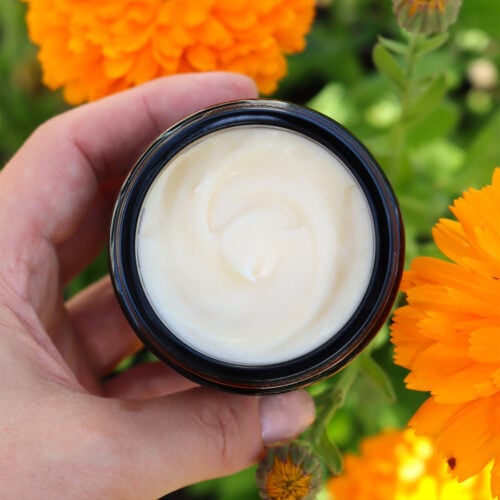
Calendula Cream Recipe
Equipment
- digital jewelers scale (to measure the ingredients by weight)
- heat-proof glass jars (2x) (Mason jars work well)
- large saucepan (or wide pot)
- square potholder (or folded kitchen towel)
- kitchen spoon (or glass stirrer)
- measuring spoons (stainless steel) (optional)
- jar lifter (optional)
- pH testing strips (optional)
Materials
Water Phase
- 55 g rose hydrosol 10 tsp / 62.19%
- 5 g vegetable glycerine 1 tsp / 5.65%
- 0.5 g baking soda (sodium bicarbonate) 1/16 + 1/32 tsp / 0.57%
Oil Phase
- 10 g calendula-infused oil 4 tsp / 11.31%
- 4 g cocoa butter or shea butter / 1.5 tsp / 4.52%
- 4 g emulsifying wax NF 1.25 tsp / 4.52%
- 1 g beeswax 1/4 tsp / or you can use 0.5 g candelilla wax to make this recipe vegan / 1.13%
Cooling Phase
- 7 g rose hydrosol 1.5 tsp / 7.91 %
- 1.5 g Geogard Ultra (Neodefend) 1/2 tsp / or another broad-spectrum preservative* such as Optiphen / 1.7%
- 10 drops rose geranium essential oil optional / or neroli or lavender essential oil / 0.5%
Instructions
Make the Calendula Infused Oil
- Before making calendula lotion, you must first make calendula oil. There are several ways to do it, and you can use different carrier oils. I use sweet almond oil for this recipe, but I also recommend apricot kernel oil. For a heavier, more conditioning lotion, you could use avocado oil or extra virgin olive oil.


Measure the Ingredients
- Measure the water-phase ingredients into one heat-proof glass jar. Measure the oil-phase ingredients into a second jar.

- Measure the cool-down phase ingredients into a small ramekin. Geogard Ultra is a broad-spectrum preservative* that comes as a powder. Mix it with the rose hydrosol until it's reasonably dispersed. You will still see small white flecks after stirring, though. Next, add the drops of essential oil to the ramekin (if you're using it). For skin safety, do not exceed the listed amounts.

Heat the Water and Oil Phases
- Create a makeshift double-boiler by placing a potholder or folded kitchen towel at the bottom of a saucepan. Set the jars containing the water phase and oil phase on top of it, then fill the pan with a couple of inches of water.
- Bring the water in the pan to a simmer. Heat the jars until the oil-phase ingredients are completely melted. Stirring helps speed this along.
- Once the oil phase is melted, remove the jars from the pan and set them on the kitchen counter. Stir both phases.
- Carefully pour the water-phase ingredients into the oil-phase jar. The contents will turn an opaque, creamy color but still be liquid. Now it's time to blend.
- Stir the ingredients together using a spoon or glass stirrer for a minute. Leave it to rest for a minute, then stir again. Repeat until the calendula cream begins thickening—it can take up to twenty minutes when stirring by hand.


Cooling Phase
- When the cream is 40°C (104°F) or cooler, add the cooling-phase ingredients and stir well*.
- Spoon the calendula cream into a clean and dry container. I use a silicone spatula to get every last drop. Allow it to cool to room temperature before sealing it with a lid.
- If you've used the Geogard Ultra preservative, the finished calendula cream recipe can have a long shelf life*. Once you start using it and putting your fingers in the cream, you should try to finish it within six months. This is a conservative personal use recommendation, not a specific shelf life.

Video
Notes
Love our recipes?
✦ Add Lovely Greens as a Google Trusted Source- Calendula (Calendula officinalis) has a long history of traditional herbal use for minor wounds, burns, rashes, and other inflammatory skin conditions. National Library of Medicine ↩︎
- “Calendula flower medicines must not be used in patients who are hypersensitive (allergic) to plants of the Asteraceae family.” European Medicines Agency — Calendulae flos ↩︎
- For food safety, the CDC recommends refrigerating homemade oils made with garlic or herbs and discarding them after four days because improperly stored oil infusions can pose a botulism risk. This guidance applies to food preparations; dried botanicals are therefore recommended for homemade calendula oil used in skincare. CDC: Botulism Prevention ↩︎
I used cetyl alcohol instead of emm wax! Will that work?
Hi Jeanie, cetyl alcohol is a thickener rather than a standalone emulsifier so it can’t be used on its own to make lotion. Emulsifying waxes sometimes include cetyl alcohol as a co-emulsifier, though. It helps thicken and create a nice emollient effect on the skin.
Hello dear Tanya and thanks a lot for for your great recipes.
Can I use BTMS 50 as emulsifying wax?
Hi Razieh, you can but I’ve not used it before. I believe that it can be used at 0.5-10% of the recipe so the amount given for e-wax in this recipe should suffice. You may need to adjust the amount though so make the smallest batch first to test it out.
I’m attempting to make a triple batch as my first attempt (also my first attempt ever making any kind of lotion) and it is not thickening even after 15 minutes of stirring. I double check all my measurements and used grams with my scale. Any idea why it isn’t thickening?
Hi Rachel, when trying any new recipe I recommend starting small – meaning not tripling this batch. That way, you won’t waste money if it doesn’t turn out the first time. Let me see if I can help, though. It can be hard to troubleshoot what happened without my being there watching you and looking at your ingredients, tools, etc. I think I may know the issue but I’ll list some additional reasons for lotion not thickening. It could be using incorrect ingredients, not stirring long enough, using an inaccurate scale, or simply not waiting for the lotion to cool down and naturally thicken. I imagine that the last reason may be what happened with you. Did you head over here to ask for help before the lotion had a chance to set? When lotion is still warm, it’s much more liquidy than when it cools to room temperature.
Thanks, it is very useful. 🖖👏
Hi Tanya.
Can I use Leucidal as perservative for this cream?
Best wishes
Rikke
Yes, you can!
Dear Tanya,
Thank you so much for the recipe for calendula cream! I am also grateful for all of your sage gardening advice!
The lotion looks lovely, but what if I would like to make more? It seems like a lot of effort for one jar? Can I just double or triple this recipe?
Thank you for all that you do,
Patti
I’ve made calendula oil before but I’m looking forward to making this as well. It’s so useful for healing!!
It really is :) And once you make calendula oil, it has so many uses! This calendula lotion, of course, but salves, body oil, bath oil, bath bombs, and other skin cream recipes.
I was just saying that I needed to use up last year’s calendula oil in some lotion! I love your recipes. Thanks
This is a wonderful way to use it! Let me know if you have any questions on making it, but do have a look at the DIY video at the end of the recipe instructions, too :)
Hi
Is the consistency of this lotion suitable for a pump bottle would you say . Can could you add and extra infused oil if halving the amount of calendula thanks Michelle
Hi Michelle, it’s a little thick for most pump bottles, I’d say, but it may be possible. To get a thinner consistency, add more distilled water or rose hydrosol. Thinner lotions are about 90% water-based.
It could be that you’ve just finished making it and you’ve not given it enough time to firm up?
Hi Valeria, I’ve updated the recipe to remove all of the volume measurements, as they’re really not very accurate. I always weigh my ingredients but for older recipes, I still include tsp, cups, etc. To thicken your lotion, I recommend using xanthan gum. Per 100ml of lotion, mix ing 1/4 xantham gum. The best way to do it is to put the xanthan gum in a small bowl then add about half a teaspoon of lotion. Mix into a paste, then add another half teaspoon. Keep doing this until the consistency of the mixture is like a thick gravy and not sticky or clumpy. Add this into the rest of the lotion and stir.
How much of the calendula flowers do you use to make the calendula infused oil?
Hi Sue, to make a small batch of calendula oil, half-fill a pint jar with dried calendula flowers, then fill the rest up with the carrier oil. Here are full instructions on how to make calendula oil.
Hi :-D
Isn’t vitamin E considered a preservative. I use it a lot in my homemade face creams and have had no problems with the creams getting rancid. Just wondering. Love your recipes so much! :-D
Chandice
It’s a common misunderstanding but no, Vitamin E is not a preservative. It will unfortunately not protect your lotions and creams from being colonized with microbes.
Sorry. In my comment response about bacterial growth, I said ‘irradiation ‘, but that was supposed to say, ‘already’.
To add to what was said,
I used to think vitamin e and c were sufficient as preservatives. I thought it was great that my products lasted 3 months or so before I saw black or green fungi. BUT I learned that loooong before you see anything, there is growth of bacteria that you can’t see. So, why would I spend good money on challenging my skin barrier with bacteria. I ended up getting a rash, from bacteria in my cream, I’m sure. Using preservatives (as close to natural as you can get) preserves your skin much better than a slow growing bacteria that you cannot see… irradiation within a week of making the product. Note that 100 percent oil products may last longer but creams with water based products in them DO NOT :).
Have fun!
Thanks to share information about hand made body care products
How much product does this recipe make?
One 100 ml pot of calendula lotion. There’s a toggle in the recipe where you can scale the recipe up to 2x or 3x, though.
Ohhhh, Thank you for this comment Tanya! You have already answered my question about more lotion💖💕💖
You’re most welcome :)
Hi Tanya, have spent the past 2 days browsing your website – so beautiful and inspiring! Thank you for being so generous in sharing your knowledge and creativity. Just wanted to ask if I could use natural beeswax as emulsifier here? And if the preservatives you mention are natural? Thank you.
Hello, and I’m so glad that you’re enjoying the ideas! Beeswax on its own isn’t an emulsifier, unfortunately. If you use a high-shear device, like a blender, you can get the semblance of emulsion, but it’s not a stable one. I have a little more information on this in the piece.
Hello Tanya. I love your beautiful site and so appreciate your generosity with recipes and ideas. I have been wanting to make this lotion but am having difficulty finding Geogard ultra in the USA. Do you have a link other than Amazon.
Hi Meredith and thank you for your kind words. Geogard Ultra is a brand name for a skincare preservative that’s made from gluconolactone and Sodium Benzoate. It’s stocked by the Soap Kitchen and The Soapery in the UK. In the USA, you can find it at Essential+labs and Mille Vertus in Canada. A similar US preservative is called NeoDefend and is stocked by Lotion Crafter.
🙏 thank you so much. You are awesome!
Hi Tanya, I absolutely love all of your lotions and potions!! Could you tell me where to find Geogard Ultra please. I am Irish and am having trouble getting it.
Thanks, Jackie
Hi Jackie, you can get it from a couple of UK suppliers now, but I’m not sure about Ireland. Try to see if the Soap Kitchen can post to you?
I measure all of my beauty ingredients with a digital scale but I’ve included volume measurements in the recipe card for convenience.
It's optional in the way the food doesn't need a preservative if refrigerated and used within a certain timeframe. For this cream you probably want to use it within a week before it begins to spoil. It should also be refrigerated during that time :)
What would you recommend for a preservative?
Geogard Ultra
Hi, I’ve been trying to buy geogard ultra but only find it in American sites. Can you buy it in Europe?
You can! I buy it from the Soap Kitchen
Great post! What a beautiful blog you have!
Thank you Amber :)
Love this! I only ever made salves and oils. Calendula works great on my skin.
Calendula is fantastic! And so easy to grow too :)
Tanya, You make everything easy…Thank you for sharing your wonderful recipes…Now to collect the things to make it…:)
Some things you’ll already have in your cupboard or garden Judy—I hope you enjoy making it!