
How to Resize a Cold Process Soap Recipe
This article contains affiliate links. As an Amazon Associate, I earn from qualifying purchases.
Wondering how to resize a soap recipe up or down to make more or less at a time? This guide explains how to scale cold process soap recipes to fit any mold or batch size. It covers the three main ways to do it (including a simple way), plus considerations for small vs. large soap batches.
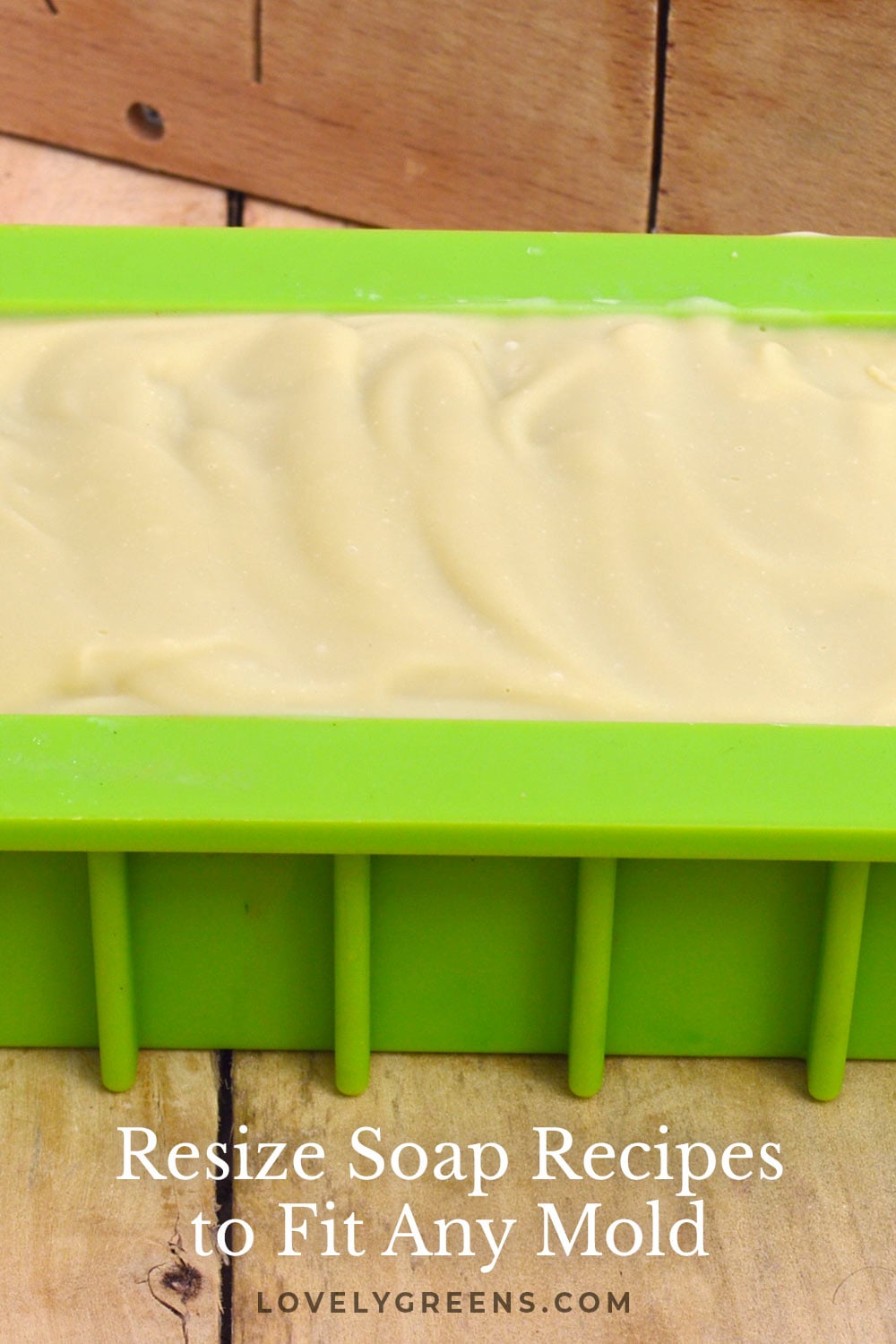

You may need to resize a cold process soap recipe for several reasons. Many beginner soapmakers want to use a soap formula from a book or online, but later want to make more soap at a time. More experienced soapmakers may want to formulate recipes to fit a specific mold(s). Then there’s buying new molds—some molds are sold online with little information on how much soap they can hold.
No matter your reason, I’ll guide you through scaling a soap recipe up or down to fit your mold while keeping it safe and true to the original. If you’re just trying to figure out what batch size to use with a specific mold, you’ll learn how to do that, too.
Small Soap Recipes
Here on Lovely Greens, almost all of the beginner soap recipes I share are small 1-lb (454 g) batches. This weight refers to the amount of oils in the formula, such as coconut oil, olive oil, and tallow. It’s grams or ounces of oil and doesn’t include water, lye, or soap additives like essential oils.

I love this batch size because it’s relatively inexpensive, stress-free, and can yield about 4-6 good-sized bars of soap. That’s plenty if you’re testing a recipe, a colorant, or just making soap for personal use. This batch size also fits well in either a small loaf mold or a 6-cavity silicone mold. So if you have one, you can reuse it indefinitely for small soap batches.

When you’re resizing soap recipes, I don’t recommend making batches smaller than this, though. You must weigh soap recipe ingredients precisely, and even a tiny error can mess up small batches. Batches smaller than 1 lb (454 g) often include tiny amounts of certain ingredients, like essential oils, that a normal kitchen scale can’t weigh accurately. If you get the lye amount off by even a fraction of a gram in a small batch, it could make the finished soap harsh on your skin.
Resizing Soap Recipes
Many soapmakers who regularly make larger batches also make 1-lb (454 g) batches when testing a new recipe, technique, or fragrance blend. It’s just large enough to make easily but small enough that it’s not a huge loss if things don’t work out. Some soapmaking ingredients are pricey, and you don’t want to use any more than you need to when trying something out.

However, 1-lb batches don’t suit everyone’s needs or circumstances. You might have a special mold you’d like to use or want to scale up to make more soap at a time. I’ve created this article for those of you who want to scale my recipes up to larger sizes. You can also use the same guidance to scale a large recipe down or create a new recipe altogether.

The three methods below offer simple ways to scale soap recipes and two ways to resize a recipe for specific molds. One calculates the fill capacity of a mold you already have, and the other estimates how much soap a mold can hold based on its internal dimensions. Lastly, I show you exactly how to use a soap calculator to scale an existing recipe to an exact batch size.
Method 1: Scaling Soap Recipes Mathematically
Many soapmakers create their own recipes, but when you’re just starting out, I think it’s best to use tried-and-tested recipes. That’s why I share so many small-batch soap recipes. In most cases, I format them into an easy-to-print recipe card with a toggle to make 1x, 2x, or 3x the recipe. This is the easiest way to resize soap recipes—it’s just simple math.
To do it, simply multiply every ingredient amount by the same factor to increase the batch size. For example, multiply each ingredient amount by 2 to double the recipe. You can also multiply each ingredient by a more specific number, such as 4.5, to make a batch four-and-a-half times the original size.
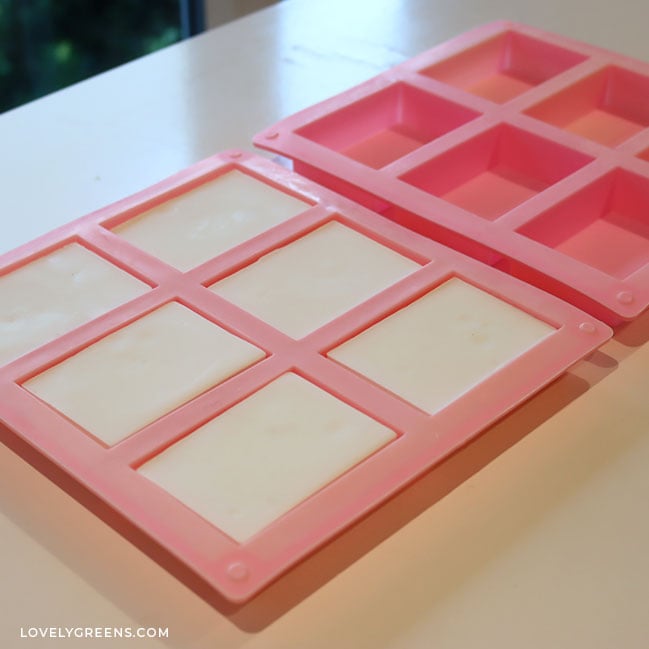
Mathematically scaling soap recipes works best when you start with a recipe that fits a particular mold. To make more at a time, you just need more of the same molds, or similar-sized ones. For example, my 1-lb soap recipes fit these cavity molds. So, you would just need a second mold to double the batch.
Understanding Mold Sizes and Capacity
You may want to scale a soap recipe to fit a mold you purchased from a soapmaking supplier. If you do, you may find it confusing to create a soap recipe that fits that mold. Online soap mold listings may not state cavity capacity, and larger slab or loaf molds are usually described by their internal dimensions or how many bars they make. You can cut soap bars from larger blocks into different sizes, so that description doesn’t mean much.
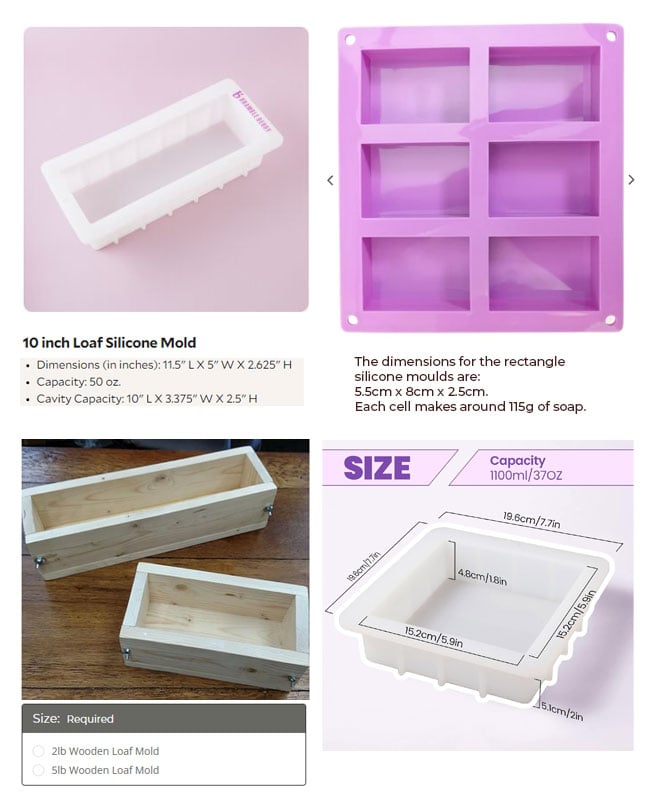
Even if a mold’s capacity is given, it can be misleading. The amount could be provided in mass (oz or grams), but sometimes it’s volume (fl. oz or ml). These are two different ways of measuring how much soap a mold can hold. For example, a mold that holds 34 fl. oz may be too small to hold a 34 oz batch of soap.

Even if the seller clearly states the capacity is weight, it still might not be clear. For example, a UK seller lists mold capacities in grams and kg, such as a 3 kg soap mold. Kilograms (kg) refer to weight (mass); however, it’s not communicated whether they mean the mold can hold 3 kg of finished soap batter or a recipe with 3 kg of soapmaking oils. The confusion grows…

My point is that soap mold capacity descriptions don’t seem standardized. If you feel confused now, or have felt that way before, you’re not alone! If you’re stuck on whether to buy a mold, reach out to the seller to clarify its capacity. At a minimum, they should be able to provide the internal dimensions of a square or rectangular mold. Then you can use the method below to determine how much soap it can hold.
Method 2: Calculating Soap Batch Size Using a Mold’s Internal Dimensions
For this method, you need the mold’s internal length, width, and height. Online soap mold listings often provide these, so you can see how much soap fits inside before you buy. If you have the mold’s internal dimensions, use these formulas to calculate the approximate soap batch size it can hold. They are different based on whether you’re using Imperial measurements (inches/ounces) or Metric (cm/grams):
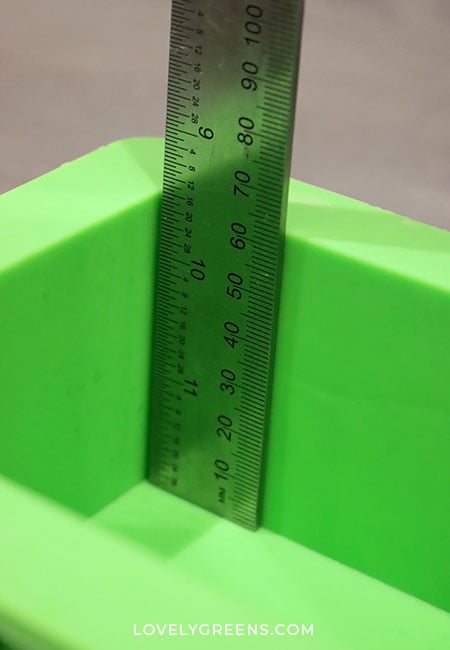
Imperial: Length (inches) x Width (inches) x Height (inches) x 0.4 = soap batch size in ounces
Metric: Length (cm) x Width (cm) x Height (cm) x 0.7 = soap batch size in grams
I’ll take you through what you do with your final figure to create a soap recipe further below—it’s in the explanation about using a soap calculator. Until then, keep in mind that it only gives you the weight of the main soapmaking oils in a soap recipe. It doesn’t include the weight of the water, lye, and soap additives.
Method 3: How to Calculate Mold Capacity by Water Weight
The last way to resize a soap batch to fit a specific mold is to measure its volume. All you do is fill a mold with liquid water and measure how much it holds in grams. This method comes in handy for odd-shaped molds, such as round molds or flower-shaped cavity molds. The only catch is that the soap mold(s) must be waterproof—silicone molds or lined in a way that protects them from moisture. If so, water can tell you how much soap you can fit in it with reasonable accuracy.
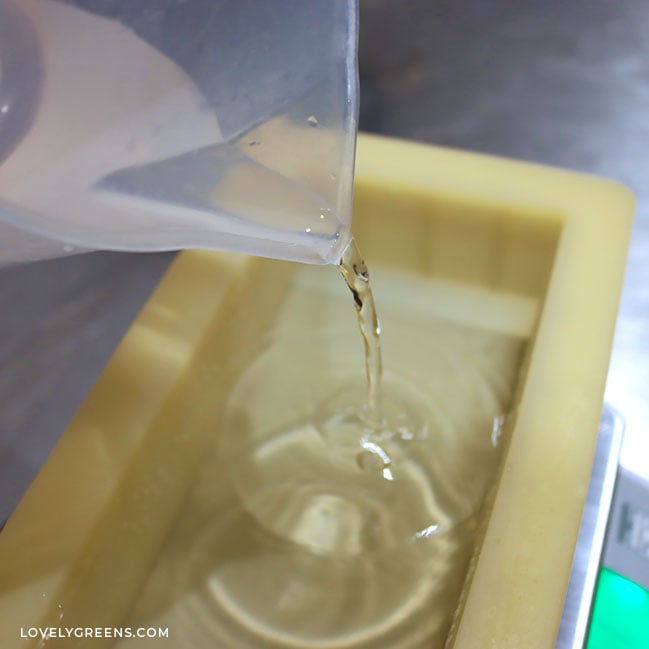
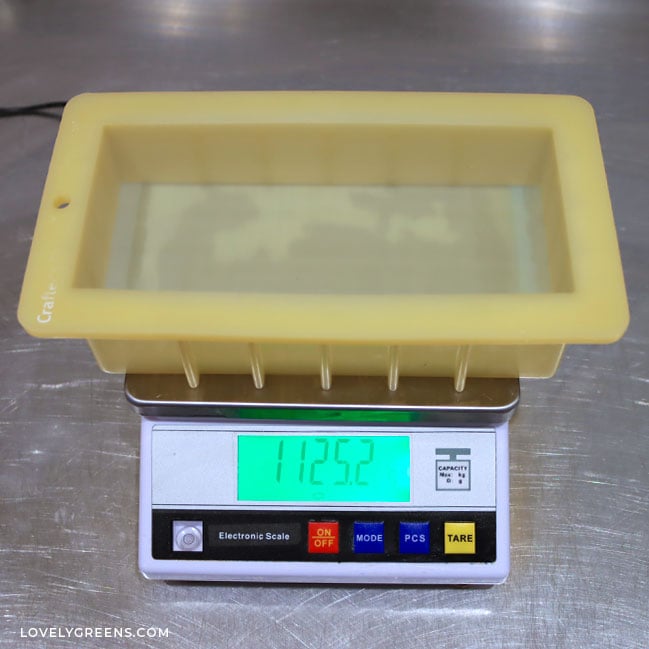
If your mold is suitable and fits easily on a scale, place it on the scale, set it to grams, and tare it. This resets the weight reading on the scale to zero. Then fill the mold with water to the level you want to pour your soap batter, and record the measurement.
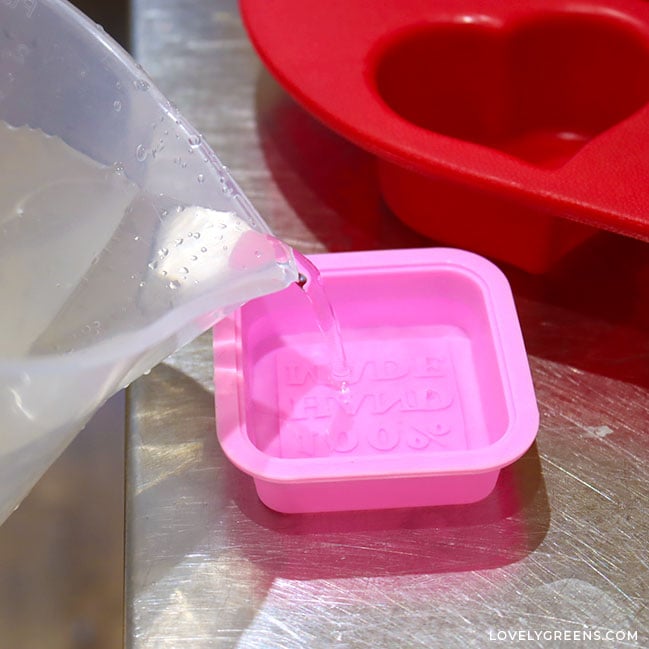
If the mold you want to use won’t fit on a scale, set it on a flat surface and fill it with tap water to the level you want to pour your soap batter. You can do this for one large mold or for several smaller ones, like cavity molds. Once filled, pour the water into a jug and measure it.
In this case, you can measure its weight or its volume in ml. Volume and weight of water correlate when using the metric system. So, 100 ml of water weighs 100 g, 5000 ml (5 L) weighs 5000 g, and so on. This doesn’t work in the imperial system, so if you prefer ounces, you’ll need to weigh the water.
Formula for Calculating Soap Batch Size
Once you have the water weight in grams, you can easily calculate the soap batch size. Use this formula to calculate the approximate weight of oils for the soap batch the mold can hold:
Total oil weight of soap recipe (grams) = Water weight (grams) x 0.7
For example, a mold holds 1000 g (35.27 oz) of water. Multiply that figure by 0.7 to get a total oil weight of 700 g (24.69 oz). This means that mold can hold a 700 g (24.69 oz) soap batch—a batch that contains that weight in soapmaking oils.
The 0.7 factor (70%) represents the average percentage of soapmaking oils in the average total weight of a soap recipe. It’s not exact but is a good approximation for most recipes and describes a typical soap recipe including lye (sodium hydroxide), water (at a 2:1 water-to-lye ratio), fragrance, and soap additives. If you have an original recipe, you can use a more specific number. Add the weight of all the soapmaking oils, then divide that figure by the total weight of all ingredients in the recipe.
Resizing a Soap Recipe
Once you have a desired batch size, use an online soap calculator to create a recipe that will fit your mold(s). You can use it to create a new soap recipe or resize an existing one—as long as the soap recipe is safe and accurate and you trust it will make good soap. If you’ve made a recipe before and liked it, that’s a good indication! You should also learn what makes a soap formula safe.
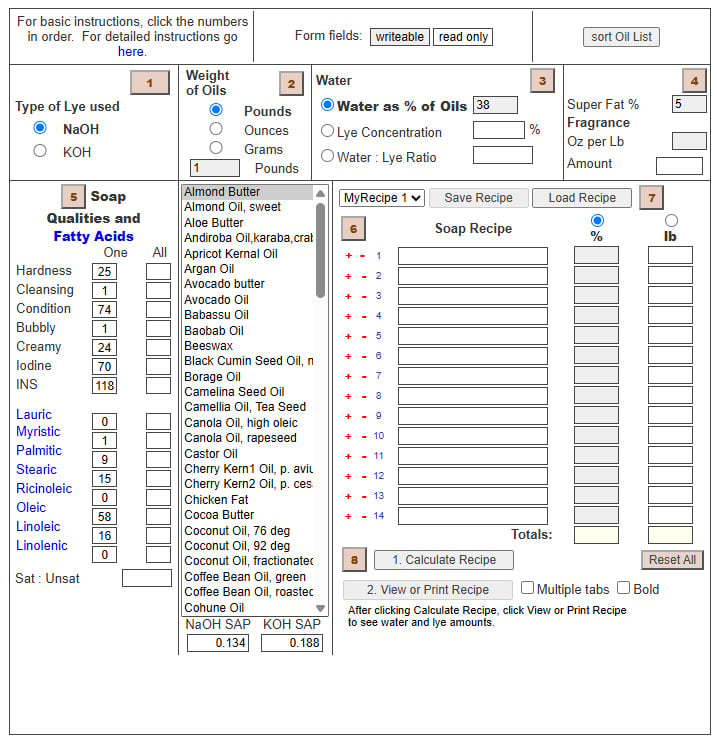
The instructions below are to help you resize an existing soap recipe. If you’re new to using a soap calculator, know that soap recipe sizes are measured by weight, and the figure you end up with using either method 2 or 3 above is the batch size. It refers to the total weight of the main soapmaking oils (Weight of Oils) in a soap recipe.
Let’s start with the original recipe and focus only on the oils, water, and lye for now. Open your preferred soap calculator—for illustration, I’ll use this free one. Your calculator may look different but should include the same fields and information. The Bramble Berry lye calculator is also popular. Either way, start by selecting the lye type: NaOH (sodium hydroxide) is used for cold-process soapmaking.
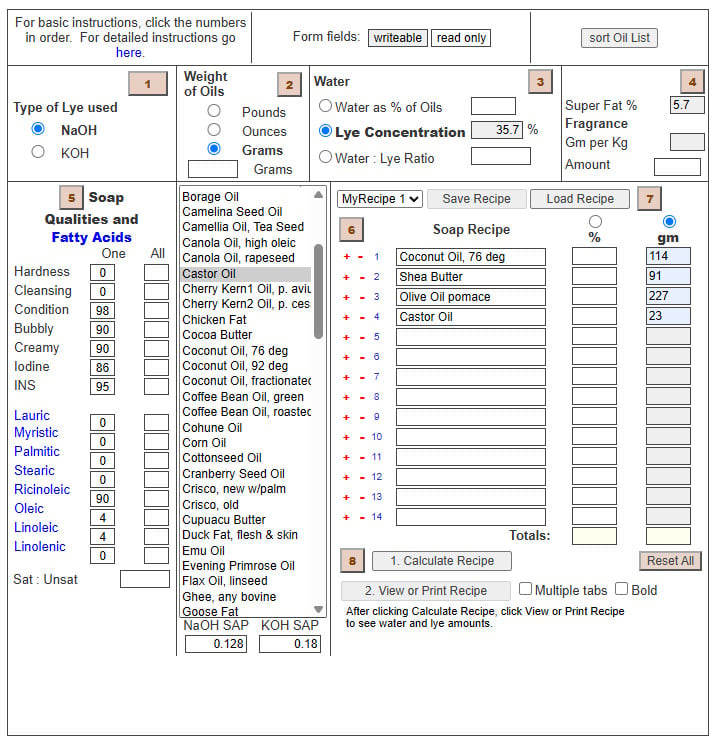
The recipe should include information on how water is calculated and the superfat level. Add that information next. If it doesn’t provide these details, set the superfat to 5% and use the ‘water-to-lye ratio’ option to calculate water. Many cold-process soaps can be made successfully with a 2:1 ratio. We can tweak these figures later if the calculated recipe doesn’t match up to the original.
To show you how this works, the images in this section use the information for this eco-friendly soap recipe. This particular recipe has a 35.7% lye concentration and a 5.7% superfat. The oils are also provided in specific amounts and percentages—I recommend using the specific amounts (in grams or oz). Enter them into the interface, then double-check that everything is entered correctly.
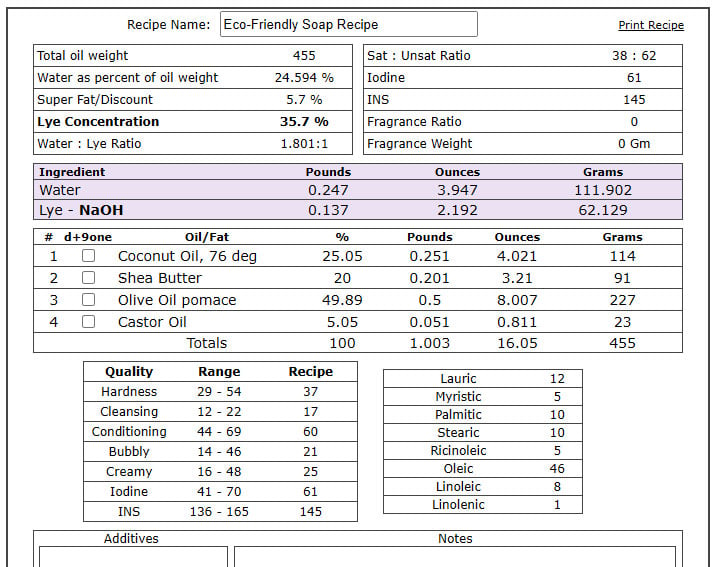
Once you’re happy with it, click ‘Calculate recipe’ or its equivalent option in your soap calculator. In mine, I also need to click the ‘View or Print Recipe’ button.
The calculated soap recipe should now be displayed. Review the ingredients, check the amounts, and confirm they match the original recipe. If they do not, go back to the original interface and tweak the superfat and water information. Increase the superfat to reduce the lye amount (and vice versa). Lower the lye concentration to increase the water amount (and vice versa).
Increase or Decrease a Soap Recipe Size
Once the original recipe is replicated as close as possible in the calculator, you can then calculate amounts for different batch sizes. Go back to the soap calculator interface, and you should see an option to switch from a unit-sized batch (such as grams/ounces) recipe to a general recipe based on oil percentages. You’ll find this option as a radio button in section 6 of this soap calculator.
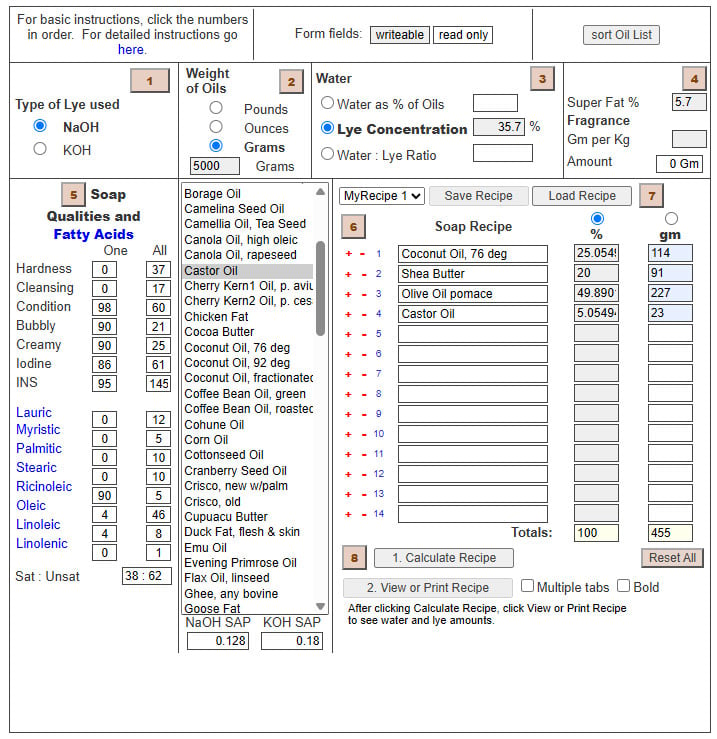
Once you’ve toggled the soap recipe to percentages, you can update the batch size to your desired size. In the soap calculator I use, you add the batch size in section 2. Press ‘Calculate Recipe,’ then ‘View or Print Recipe,’ and you’ll get a custom-sized version of the original that should closely fit your exact mold(s).
Soap calculator recipe measurements are often given in decimals, so you may need to round to the nearest workable number for your digital scale. With grams, round to the closest whole number; with oz, round to two decimal places. Before making the recipe, enter the rounded numbers back into the soap calculator and make sure the superfat matches your target.
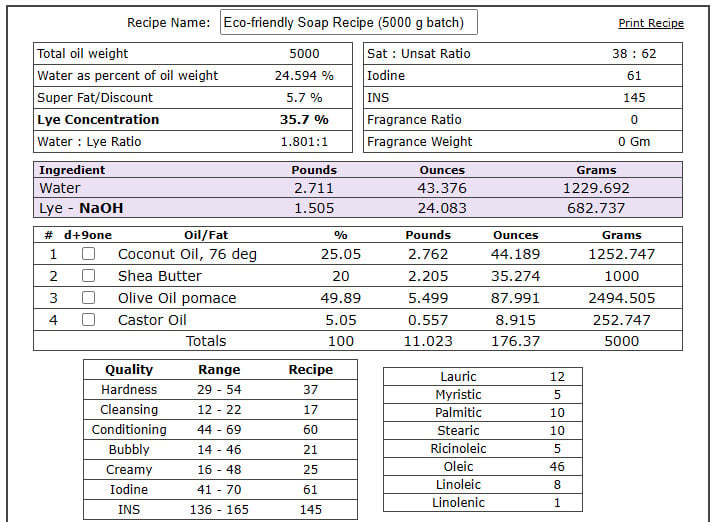
After you have your finished batch size, you can calculate how much fragrance (essential oils or fragrance oils), colorant, and other soap additives you need. Each ingredient has an ideal and maximum usage rate, and soap calculators can’t account for all of them. I always do this manually and stick to safe maximum usage rates for each ingredient. This is particularly important with fragrance oils and essential oils.
Differences in Making Small vs Large Soap Batches
Making small batches of soap is much like making large batches. However, differences can include how much heat the soap retains and whether it gels naturally—larger batches do both better. Some factors that might be problematic are how quickly the soap traces (thickens) and how much time you have to work with it before it hardens.

Soap recipe ingredients are often the main factor. High percentages of hard oils, like coconut oil, can make soap batter trace faster than soft oils, like olive oil. If you use a fragrance oil or essential oil that causes acceleration (fast trace), it can be hard to get it into molds before it sets. If it’s an issue in a small batch, it will be a real headache in larger batches!
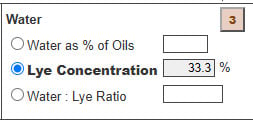
My advice: start by making new soap recipes in small 1-lb (454 g) batches, and keep notes on how quickly they trace. If it’s fast in small recipes, the issue will feel a lot worse in larger ones. If you’re sure the recipe is good but it still feels a little slow to trace, or if you get soda ash or soft soap when you unmold, try reducing the water a little to counter it—this technique is called water discounting. On the other hand, to slow soap tracing or help the soap gel more easily, you can increase the water slightly.
If the recipe has a big problem and needs work, try to identify the possible cause(s). Learning to use a soap calculator can help you edit or change the soap recipe or create a new one.
Formulating a New Soap Recipe
In this piece, I’ve shared advice on resizing a soap recipe to fit a specific mold or simply increase the batch size. These are useful skills, and you’ll probably use them many times in your soapmaking. Knowing how to scale up an existing soap recipe works for recipes from soapmaking books, Lovely Greens, or other sources. It also works for your own recipes.
If you’d like to learn how to create your own, you can read how to formulate a soap recipe. It involves understanding more about the fatty acids and properties that different oils and fats can give your soap. If you’re a beginner, I recommend starting with tried-and-tested recipes to build experience. Here are a few more resources that you’ll find useful: